USAID
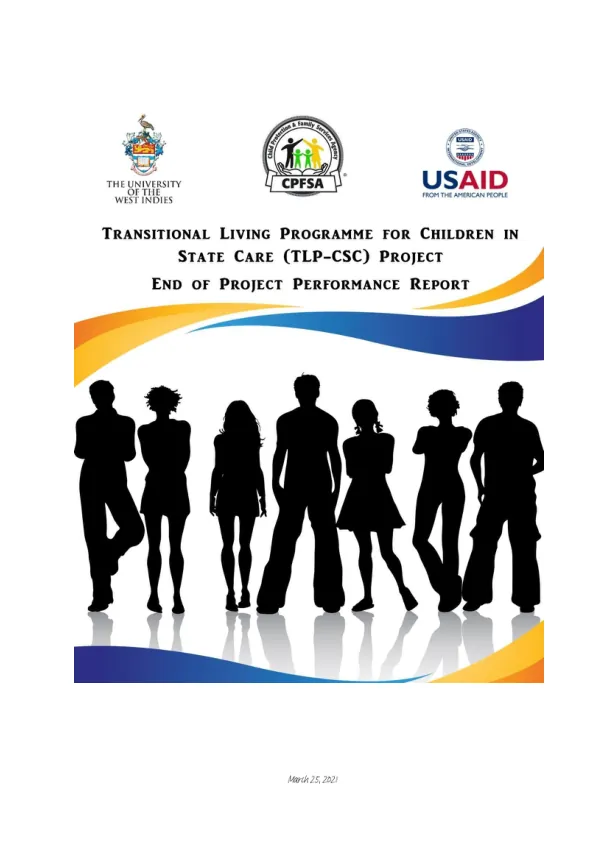
Transitional Living Programme for Children in State Care (TLP-CSC) Project
The Transitional Living Programme for Children in State Care (TLP-CSC) Project was implemented from August 27, 2014, to December 24, 2020, with a duration of 76 months.
2021 · 128 pages
Sign in to readA free account is required to download.
Abstract
The project aimed to improve the transition to independent living outcomes of youth leaving residential care at 18 years old and reduce the effects of risk factors associated with low skill development, inadequate life skills, and self-image. The project was implemented by The University of the West Indies Open Campus, in partnership with The Child Protection and Family Services Agency (CPFSA), with funding from the United States Agency for International Development (USAID). The total cost of the project was US$5,379,265, with USAID funding amounting to US$4,339,389 and a counterpart contribution of US$1,039,876 from the Government of Jamaica and The University of the West Indies. The project's goal was to improve the transition to independent living outcomes of youth leaving residential care at 18 years old. To achieve this goal, the project implemented several interventions, including farmer training programs, infrastructure development, and market linkage facilitation. The project also provided mentorship, life skills training, and vocational skills training to the youth. The project's target area was Independent Living, and the beneficiaries were children in the care of the State. The project's implementation was overseen by a Project Steering Committee, which included representatives from the Government of Jamaica, The University of the West Indies, and other stakeholders. The project's monitoring and evaluation framework included regular meetings, performance and financial reporting, and an independent external evaluation. The project's financial report showed that the project was implemented within budget, and the project's achievements were in line with the project's output targets. The project's achievements included the provision of mentorship, life skills training, and vocational skills training to the youth, as well as the establishment of a housing assistance program. The project's lessons learned and recommendations included the need for continued support for the youth after they leave residential care, the importance of providing vocational skills training to equip the youth with employable skills, and the need for continued monitoring and evaluation to ensure that the project's achievements are sustained. The project's publications and conference presentations included several reports and papers on the project's achievements and lessons learned. The project's appendices included several tables and figures that provided additional information on the project's implementation and achievements. The project's impact was significant, with the youth benefiting from the mentorship, life skills training, and vocational skills training provided by the project. The project's achievements were in line with the project's output targets, and the project's financial report showed that the project was implemented within budget.