USAID DEC
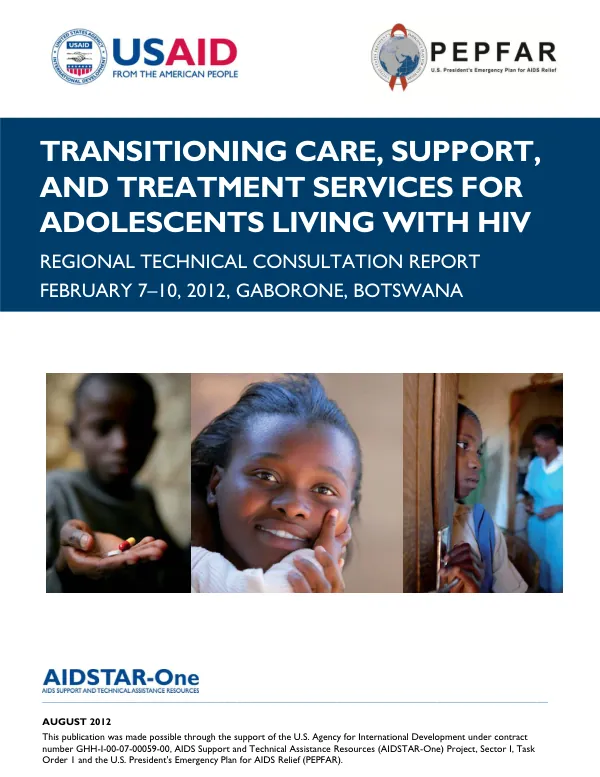
Transitioning Care, Support, and Treatment Services for Adolescents Living with HIV: Regional Technical Consultation Report
Sign inENCOMPASS, LLC
Transitioning Care, Support, and Treatment Services for Adolescents Living with HIV: Regional Technical Consultation Report
Advances in antiretroviral therapy (ART) and improved health services mean that increasing numbers of children infected with HIV perinatally will survive into adulthood.
2012 · 36 pages
Sign in to readA free account is required to download.
Abstract
This group is emerging as a unique population that presents a special challenge to programmers, and service providers, who need to support their health and development. The Prevention of Mother-to-Child Transmission/Pediatric Technical Working Group (TWG) of the U.S. President’s Emergency Plan for AIDS Relief (PEPFAR), the Africa Bureau of the U.S. Agency for International Development (USAID), and AIDSTAR-One held a consultation in Gaborone, Botswana, from February 7 to 10, 2012, to enable participants from eight countries to exchange knowledge and experiences in transitioning care, support, and treatment services for adolescents living with HIV (ALHIV). Participants included representatives of U.S. Government agencies, PEPFAR implementing partners, ministries of health, and civil society organizations, as well as youth participants from communities affected by HIV in Botswana, Kenya, Mozambique, Namibia, and Zambia. The consultation aimed to address the challenges faced by adolescents living with HIV as they transition from pediatric to adult care. This transition can be both a mental and physical challenge, and given the limited number of health providers in sub-Saharan Africa, many adolescents may not physically transition to a new provider or to a new clinic. However, all adolescents will undergo a mental transition to adulthood that will require an increase in their ability to manage their HIV. Practitioners, government officials, and service providers need to understand the special needs of this population to support their health and development. The consultation brought together experts and stakeholders to share experiences and best practices in transitioning care, support, and treatment services for ALHIV. Participants discussed the importance of meaningful involvement of people living with HIV/AIDS, facility-based services, community, family, and personal services, monitoring and evaluation, and quality improvement. The meeting also focused on the current recommendations of UNICEF guidelines and the development of a Transition Toolkit for health and community care providers, families/caregivers, and adolescents. The Transition Toolkit aims to provide guidance and support for adolescents living with HIV as they transition from pediatric to adult care. The toolkit includes information on the importance of meaningful involvement of people living with HIV/AIDS, the role of facility-based services, community, family, and personal services, and the need for monitoring and evaluation. The toolkit also provides guidance on how to support adolescents living with HIV as they transition to adulthood and how to address the challenges they face. The consultation and the development of the Transition Toolkit are part of a broader effort to improve the health and well-being of adolescents living with HIV. The goal is to ensure that these young people receive the care and support they need to manage their HIV and to live healthy and productive lives. The Transition Toolkit and the recommendations of the consultation will help to inform policy and practice to support the health and development of adolescents living with HIV. The consultation and the development of the Transition Toolkit have been supported by the U.S. President’s Emergency Plan for AIDS Relief (PEPFAR) through the U.S. Agency for International Development (USAID) under the terms of contract no. GHH-I-00–07–00059–00. The project is implemented by John Snow, Inc. in collaboration with Broad Reach Healthcare, Encompass, LLC, International Center for Research on Women, MAP International, Mothers 2 Mothers, Social and Scientific Systems, Inc., University of Alabama at Birmingham, the White Ribbon Alliance for Safe Motherhood, and World Education.