AVENIR HEALTH
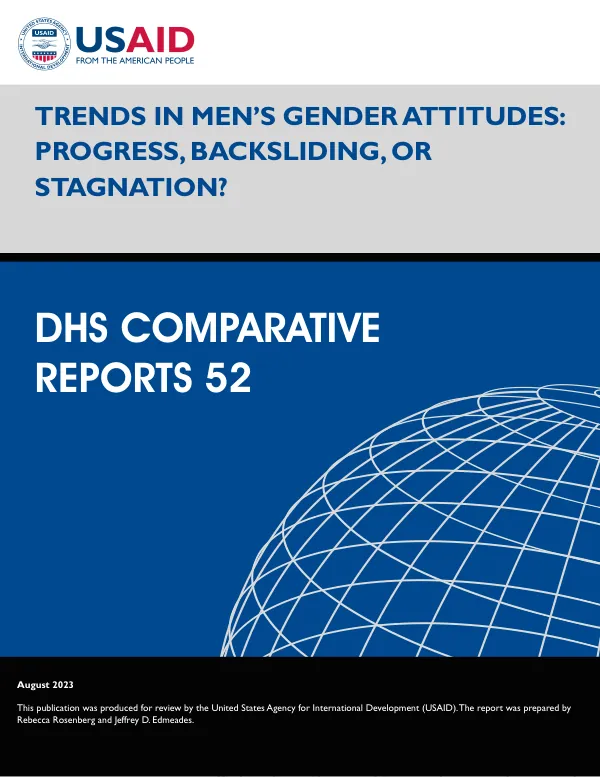
Trends in Men’s Gender Attitudes: Progress, Backsliding, or Stagnation?
The DHS Comparative Reports No.
2023 · 49 pages
Sign in to readA free account is required to download.
Abstract
52, Trends in Men's Gender Attitudes: Progress, Backsliding, or Stagnation, examines the evolution of men's attitudes toward gender equality over time. The report focuses on five key indicators: justification for intimate partner violence, women's involvement in household decisions, women's sexual autonomy, contraceptive use, and son preference. The study utilizes data from multiple survey waves, including those from the Demographic and Health Surveys (DHS) program. The analysis covers a range of countries, with a focus on trends in men's attitudes over time. The report identifies significant variations in men's attitudes across different regions and countries. The data reveal that men's attitudes toward intimate partner violence have shown a mixed trend, with some countries experiencing a decline in acceptance of violence while others have seen an increase. In contrast, men's attitudes toward women's involvement in household decisions have generally improved, with a greater proportion of men reporting that women should have a say in major household purchases. The report also examines men's attitudes toward women's sexual autonomy, finding that a significant proportion of men continue to hold restrictive views on women's sexual behavior. However, there is evidence of a decline in men's attitudes toward women's contraceptive use, with a greater proportion of men reporting that women should have control over their own reproductive health. Son preference is another key indicator examined in the report, with data showing that men's attitudes toward son preference have remained relatively stable over time. However, there is evidence of a decline in men's attitudes toward the importance of having sons, particularly in countries with high levels of gender inequality. The report concludes that men's attitudes toward gender equality have shown a mixed trend over time, with some countries experiencing progress while others have seen backsliding or stagnation. The findings have significant implications for policy, programming, and future research, highlighting the need for targeted interventions to address the root causes of gender inequality. The analysis also reveals that men's attitudes toward gender equality are closely tied to broader social and cultural norms, with countries with higher levels of gender inequality tend to have more restrictive attitudes toward women's rights. The report emphasizes the importance of addressing these underlying factors in order to promote greater gender equality and improve the lives of women and men. The study's findings have important implications for policymakers and program implementers seeking to promote gender equality and improve the lives of women and men. The report highlights the need for targeted interventions to address the root causes of gender inequality, including restrictive social and cultural norms. The analysis also underscores the importance of monitoring and evaluating progress toward gender equality, using data from surveys and other sources to track trends in men's attitudes over time. By doing so, policymakers and program implementers can identify areas where progress is being made and where further action is needed to promote greater gender equality. The report's findings also have implications for future research, highlighting the need for further analysis of the complex factors driving men's attitudes toward gender equality. By examining the interplay between social, cultural, and economic factors, researchers can gain a deeper understanding of the root causes of gender inequality and develop more effective strategies for promoting greater equality.
![Regional Disparities and Determinants of Anemia and Modern Contraceptive Use among Women in Myanmar [FA126]](https://covers.devme.ai/gen/143956.webp)