USAID DEC
Regional Disparities and Determinants of Anemia and Modern Contraceptive Use among Women in Myanmar [FA126]
Sign inAVENIR HEALTH
Regional Disparities and Determinants of Anemia and Modern Contraceptive Use among Women in Myanmar [FA126]
Regional disparities in anemia and modern contraceptive use among women in Myanmar are significant concerns for public health.
2019 · 43 pages
Sign in to readA free account is required to download.
![Regional Disparities and Determinants of Anemia and Modern Contraceptive Use among Women in Myanmar [FA126]](https://covers.devme.ai/gen/143956.webp)
Abstract
The 2015-16 Myanmar Demographic and Health Survey (MDHS) collected data on fertility, family planning, maternal and child health, nutrition, and HIV/AIDS. This further analysis of the MDHS aimed to determine regional disparities and determinants of anemic health outcomes and use of modern contraception methods by women of reproductive age in Myanmar. The study used cross-sectional data from the MDHS, with a weighted sample of 12,489 eligible women of reproductive age (age 15-49) for the anemic outcome. Analysis of modern contraception use was restricted to a weighted sample of 12,419 women age 15-49 who were not currently pregnant. The results showed that there are regional disparities in anemia and use of modern contraception within geographical zones, with the disparities across States and Regions in Myanmar being especially large. Rakhine State in the Coastal zone was the most vulnerable region for anemic disparities, with a prevalence of 55.4%. In contrast, women of Chin State (17.5%) in the Hilly zone and Rakhine State (23%) in the Coastal zone were the least likely to use modern contraception. The determinants for anemia were found to be biological and factors related to pregnancy, rather than socioeconomic factors. On the other hand, the determinants of the use of modern contraception methods were region, age, education, marital status, wealth, and number of children. The findings of this study have important implications for public health policy and programming in Myanmar. Understanding the regional disparities and determinants of anemia and modern contraceptive use can help to reduce the anemic burden, unwanted pregnancy, and related deaths. The study highlights the need for targeted interventions to address the specific needs of different regions and populations in Myanmar.
Related documents
Documents in this collection
 2018
2018USAID DEC
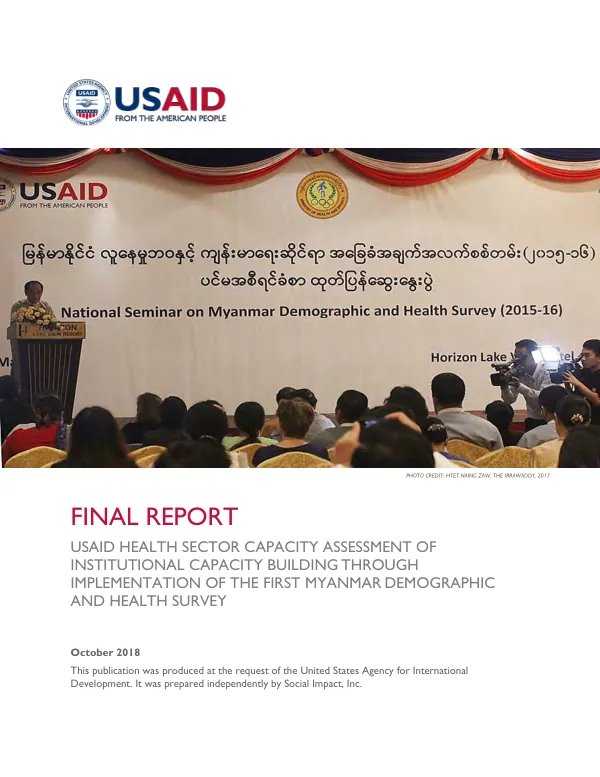
USAID Health Sector Capacity Assessment of Institutional Capacity Building Through Implementation of the First Myanmar Demographic and Health Survey
Open record 2015
2015USAID DEC