USAID
Trichoderma, the fighting fungus
Trichoderma, a fungus, has been identified as a valuable tool in combating fungal diseases that affect crops in developing countries.
2012 · 2 pages
Sign in to readA free account is required to download.
Abstract
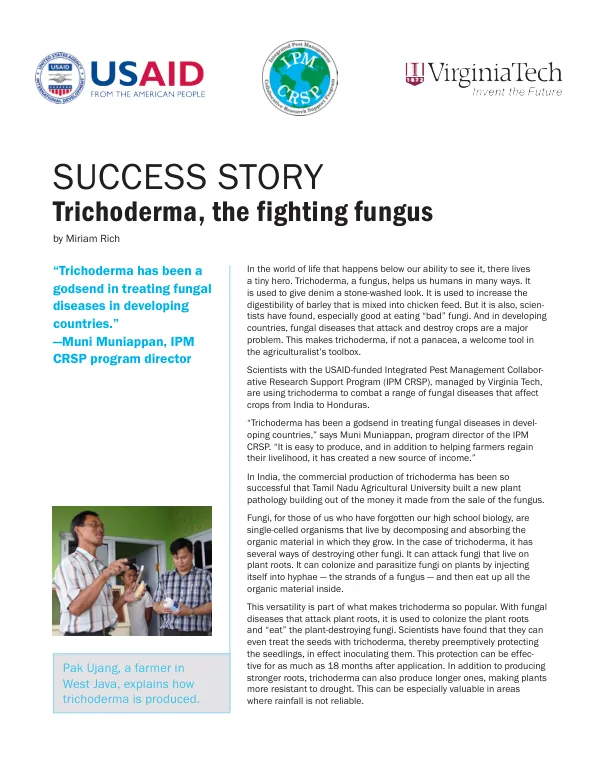
Scientists with the USAID-funded Integrated Pest Management Collaborative Research Support Program (IPM CRSP), managed by Virginia Tech, are utilizing trichoderma to combat a range of fungal diseases that affect crops from India to Honduras. Trichoderma has been found to be effective in treating fungal diseases that attack plant roots, as well as foliar fungal diseases. It can colonize and parasitize fungi on plants by injecting itself into hyphae and then consuming the organic material inside. This versatility makes trichoderma a popular choice among farmers and scientists alike. In addition to producing stronger roots, trichoderma can also produce longer ones, making plants more resistant to drought. In India, the commercial production of trichoderma has been so successful that Tamil Nadu Agricultural University built a new plant pathology building out of the money it made from the sale of the fungus. In Indonesia, trichoderma is used against clubroot, which attacks broccoli, while in the Philippines, it is used to combat anthracnose bulb rot, damping off, and pink rot, diseases that decimated fields of onion before trichoderma came to the rescue. Trichoderma occurs naturally in nearly all soils, making it easy to find and cultivate. Producers can mix it with compost and sell it in bags, or produce it in liquid form to be sprayed on leaves for the treatment of foliar fungal diseases. The fungus is widely applicable and can be used to combat almost every pathogenic fungus that people want to control. In Bangladesh and Indonesia, trichoderma is mixed with compost and applied in the field to combat soilborne diseases of vegetable crops, oil palm, citrus, vanilla, langsat, durian, and cacao. In India and the Philippines, the fungus is sprayed on seedlings as a treatment for vegetable crops. Pak Ujang, a farmer in West Java, has made a successful on-farm business venture out of producing trichoderma to share with farmer groups in his area. The IPM CRSP is supported by a grant from USAID and managed by Virginia Tech's Office of International Research, Education, and Development (OIRED). Collaborators on the project include Mike Hammig, principal investigator for the IPM CRSP Southeast Asia program, Ed Rajotte, principal investigator for the IPM CRSP South Asia program, and Jeff Alwang, principal investigator for the IPM CRSP Latin America and the Caribbean program. Funding for the project is provided by USAID, and the IPM CRSP is managed by Virginia Tech's Office of International Research, Education, and Development (OIRED). The project director is Muni Muniappan, who can be contacted at (540) 231-3516 or [email protected]. The administrative principal investigator is Michael Bertelsen, who can be contacted at (540) 231-6338 or [email protected].
Related documents