INTERNATIONAL ORGANIZATION FOR MIGRATION
Social and Environmental Soundness Issues in REDD+
Social and Environmental Soundness Issues in REDD+ began with the evolution of RED to REDD to REDD+.
2012 · 10 pages
Sign in to readA free account is required to download.
Abstract
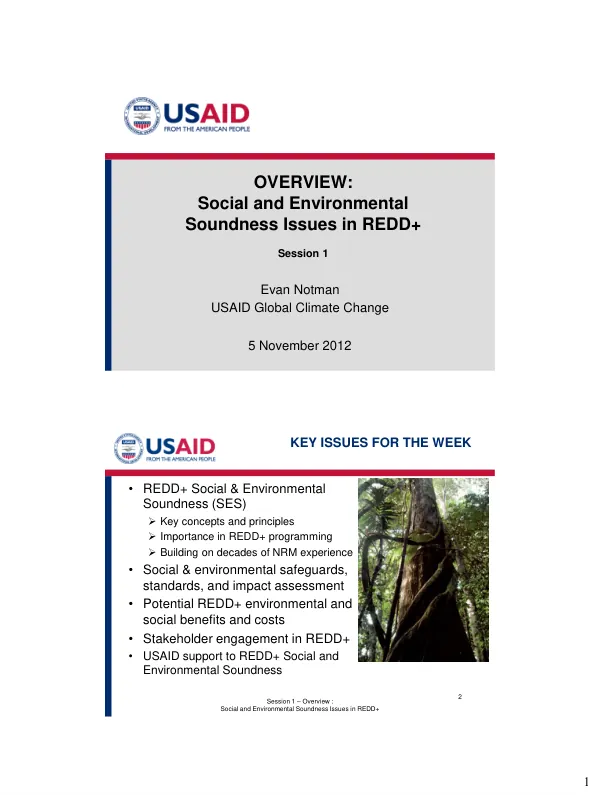
The concept of REDD+ emerged from the Montreal 2005 conference, where the focus was on reducing emissions from deforestation. The Bali 2007 conference expanded the scope to include reducing emissions from deforestation and degradation. The Poznan 2008 conference further broadened the focus to include the role of conservation, sustainable management of forests, and enhancement of forest carbon stocks in reducing emissions. The USG REDD+ Strategy, released in 2010, emphasized the importance of social and environmental soundness in REDD+ planning and implementation. The strategy listed social and environmental aspects of REDD+ as a policy priority and aimed to provide leadership on this theme among REDD+ donors. The USAID Climate Change and Development Strategy, released in January 2012, identified social and environmental soundness as a key element in the USG REDD+ strategy. The strategy aligned with the USAID's overall goal of enabling countries to accelerate their transition to climate-resilient, low-emissions development. The strategy had three strategic objectives: accelerating the transition to low-emission development, increasing resilience of people, places, and livelihoods, and strengthening development outcomes by integrating climate change in USAID programming. Forest emissions in national context were addressed through national development planning, which integrated the forest sector into broader processes for long-term, climate-resilient development. The LEDS (Low Emission Development Strategies) initiative supported countries in understanding their emissions profile, identifying and analyzing mitigation options, and recognizing gaps in information. The USG's EC-LEDS Program organized a framework for support, facilitated an integrated approach, and coordinated inter-agency efforts. REDD+ was part of economy-wide LEDS efforts, addressing drivers of emissions from deforestation and degradation, reducing pressures on forest conversion for agriculture, and improving efficiency of biomass energy use. USAID programs on REDD+ included the Global Climate Change initiative, which supported work in three areas: clean energy, adaptation, and sustainable landscapes. The Forest Carbon, Markets and Communities (FCMC) program worked in four areas, including social and environmental soundness, and aimed to contribute to international REDD+ architecture and strengthen social and environmental elements for country-level REDD+ readiness and implementation. The FCMC SES activities helped USAID meet its ambitious SES goal in the USG REDD+ Strategy. The program was a global strategic program, operating in Washington, DC, but also supporting work on regional and national levels. The LEAF (Lowering Emissions in Asia's Forests) program had four objectives: replicating and scaling-up innovation through regional platforms and partnerships, establishing policy and market incentives for GHG reductions, building and institutionalizing technical capacity for economic valuation of forest ecosystem services and monitoring changes in forest carbon stocks, and demonstrating innovation in sustainable land management. The LEAF program was a regional program, working closely with the USAID Regional Development Mission for Asia (RDMA). The program focused on six core countries and had a replication strategy for other countries. The LEAD (Low Emissions Asian Development) program complemented the EC-LEDS initiative by working in 11 countries to build capacity in LEDS, GHG inventories, and carbon market development, facilitating regional cooperation and knowledge-sharing, and promoting LEDS and public-private partnerships. Social and environmental soundness referred to the feasibility and compatibility of development with local cultural, socio-economic, and environmental conditions. The SES approach involved policies, tools, and best practices to ensure that SES was achieved in development. Key elements of SES included safeguards and safeguard information systems, standards, impact assessments, benefits and costs, and stakeholder engagement, rights, and benefit-sharing. In international REDD+ discussions, SES often referred to social and environmental safeguards or social and environmental standards. However, USAID used SES to refer to social and environmental soundness. The importance of SES for REDD+ included social and environmental safeguards, standards, impact assessment, stakeholder participation, human rights, and biodiversity. SES fostered collaboration with other donors and partners. The key principles for REDD+ SES included do no harm, do good, and no regrets. Do no harm involved avoiding negative social and environmental impacts, while do good involved increasing positive social and environmental benefits. No regrets involved undertaking development activities that would be beneficial irrespective of global negotiations on REDD+ financing. Safeguards were measures to protect against or minimize social and environmental damage or harm, while standards were measures that assessed performance in comparison with agreed criteria. Building capacity for effective stakeholder engagement and good governance, rights to land, trees, and carbon, multiple benefits and costs, social and environmental impact assessment, cost and benefit sharing, livelihoods, ecosystem services, and biodiversity conservation were key SES issues.
Related documents