MANAGEMENT SYSTEMS INTERNATIONAL
Tusome (“Let’s Read”) External Evaluation
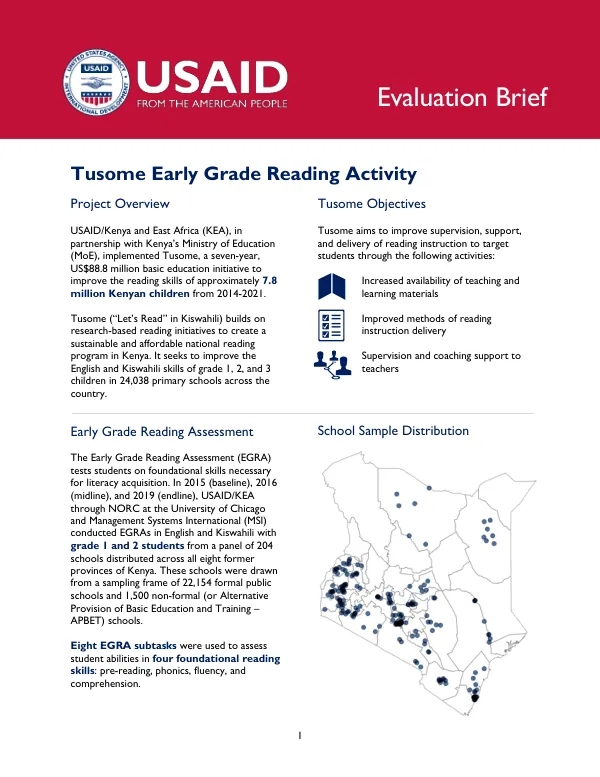
The Tusome Early Grade Reading Activity was a seven-year, US$88.8 million basic education initiative implemented by USAID/Kenya and East Africa (KEA) in partnership with Kenya's Ministry of Education (MoE) from 2014 to 2021.
2021 · 4 pages
Sign in to readA free account is required to download.
Abstract
The initiative aimed to improve the reading skills of approximately 7.8 million Kenyan children in 24,038 primary schools across the country. Tusome, which translates to "Let's Read" in Kiswahili, built on research-based reading initiatives to create a sustainable and affordable national reading program in Kenya. The Tusome initiative focused on improving supervision, support, and delivery of reading instruction to target students through various activities, including increased availability of teaching and learning materials, improved methods of reading instruction delivery, and supervision and coaching support to teachers. The Early Grade Reading Assessment (EGRA) was conducted in 2015 (baseline), 2016 (midline), and 2019 (endline) to assess students' foundational reading skills in English and Kiswahili. The assessment consisted of eight subtasks that evaluated students' abilities in pre-reading, phonics, fluency, and comprehension. The evaluation results provided strong evidence for the efficacy of the Tusome model of instruction. From baseline to endline, pupils showed statistically significant improvements on all EGRA subtasks in both English and Kiswahili. Grade 2 English reading gains observed from baseline to endline were roughly equal to gains from an additional full year of schooling. Exposure to Tusome consistently corresponded with reading performance, and reduced exposure to Tusome under the revised Competency-Based Curriculum (CBC) timetable corresponded with a decrease in reading performance. Despite the progress made, the vast majority of early grade learners in Kenya were still unable to read at a grade-appropriate level. The number of non-readers (or zero readers) dropped considerably between baseline and endline, while the number of fluent and emergent readers increased for both grade levels and languages. However, fewer than eight percent of grade 1 and 2 pupils were able to read Kiswahili at a grade-appropriate level, and in English, just 14 percent of grade 1 pupils and 18 percent of grade 2 pupils were meeting Kenya's reading benchmarks. The reduction in English and Kiswahili instructional hours under the new CBC timetable appeared to be a driver of declines in reading performance since midline. At endline, teachers were on average around 30 (of 150 total) Tusome lessons behind midline levels due to the reduction in instructional time. Reduced exposure to Tusome appeared to have negatively impacted children's English and Kiswahili skills. Regular reading practice and classroom resources were positively correlated with reading fluency, while larger class sizes and the use of local language at school were negatively correlated with reading fluency. Pupils who reported reading stories at home and/or reading aloud at school scored 3-6 correct words per minute higher than those who didn't, holding all else constant. Teachers generally demonstrated moderate to high levels of support for Tusome, yet faced a number of implementation challenges, including insufficient time to cover the content and Tusome lesson pacing being too fast. Tusome was largely successful in securing ownership and buy-in from the Government of Kenya (GoK) at different levels of government and at different points in the implementation process. However, more work was needed to ensure long-term sustainability, particularly upholding existing procedures, policies, and guidelines, such as the centralized book procurement procedure.