U.S. DEPARTMENT OF STATE/OES
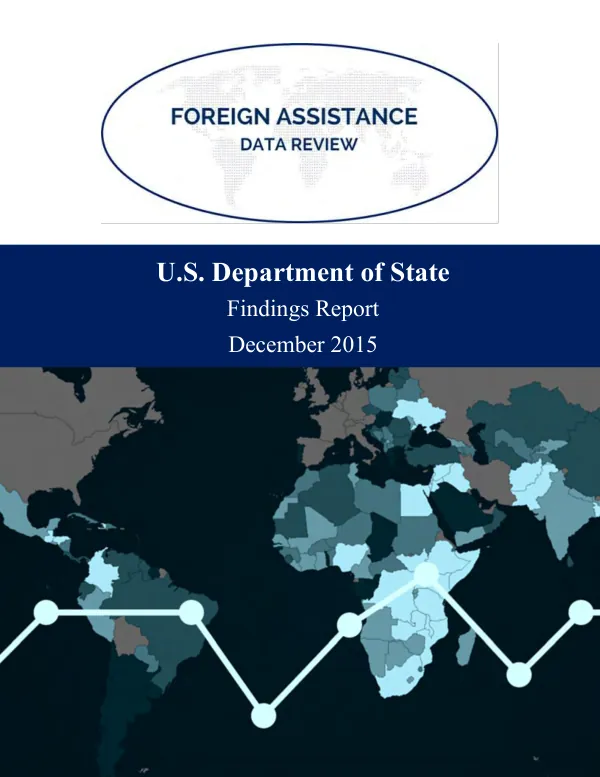
U.S. Department of State 2015 Foreign Assistance Data Review Findings Report
The Department of State captures foreign assistance activity from budget planning and allocation through obligation and disbursement in multiple budget, financial, and program management systems.
2015 · 37 pages
Sign in to readA free account is required to download.
Abstract
However, the Department does not fully utilize these systems to track or report on foreign assistance programs or funds at the level needed for recent transparency, congressional, or management purposes. The Foreign Assistance Data Review (FADR) working group was chartered in September 2014 to understand and document these issues and recommend a path forward. The FADR working group conducted a comprehensive review of the Department's foreign assistance data management processes, including budgeting, appropriations, congressional notification, apportionment, allotment, and funds distribution. The review also examined the Department's current systems for tracking and reporting foreign assistance, including ForeignAssistance.gov, budget to obligation to expenditure, bulk obligations, pipeline reviews, and requests that pre-date existing systems. The review identified several key findings, including gaps and challenges in the Department's current processes and systems. These findings included the need to standardize sector, agency, and vendor names, project titles, and project codes, as well as the need to expand the use of the SAMS Sector and Country codes. The review also identified the need for a prototype data viewer to improve data visualization and analysis. Based on these findings, the FADR working group made several recommendations for improving the Department's foreign assistance data management processes and systems. These recommendations included developing a standard foreign assistance management business process, identifying changes to existing systems and new system requirements, and developing an integrated system solution to meet all requirements of the foreign assistance business process. The working group also recommended establishing a single foreign assistance business process, identifying a system solution for foreign assistance management, and developing and implementing the system solution. The expected impact of these recommendations includes improved transparency, accountability, and management of foreign assistance programs and funds. The recommendations are expected to enhance the Department's ability to track and report on foreign assistance, improve data visualization and analysis, and increase the efficiency and effectiveness of foreign assistance programs. The Department of State's foreign assistance data management processes and systems are critical to ensuring the effective and efficient management of foreign assistance programs and funds. The FADR working group's recommendations provide a path forward for improving these processes and systems, and are expected to have a significant impact on the Department's ability to track and report on foreign assistance, as well as to improve transparency, accountability, and management of foreign assistance programs and funds. The Department of State's foreign assistance data management processes and systems are complex and involve multiple stakeholders and systems. The FADR working group's recommendations provide a framework for improving these processes and systems, and are expected to have a significant impact on the Department's ability to track and report on foreign assistance, as well as to improve transparency, accountability, and management of foreign assistance programs and funds. The implementation of the FADR working group's recommendations will require significant resources and effort, including the development of new systems and processes, as well as the training of Department staff. However, the expected benefits of these recommendations, including improved transparency, accountability, and management of foreign assistance programs and funds, make them a critical step forward for the Department.
Related documents