USAID DEC
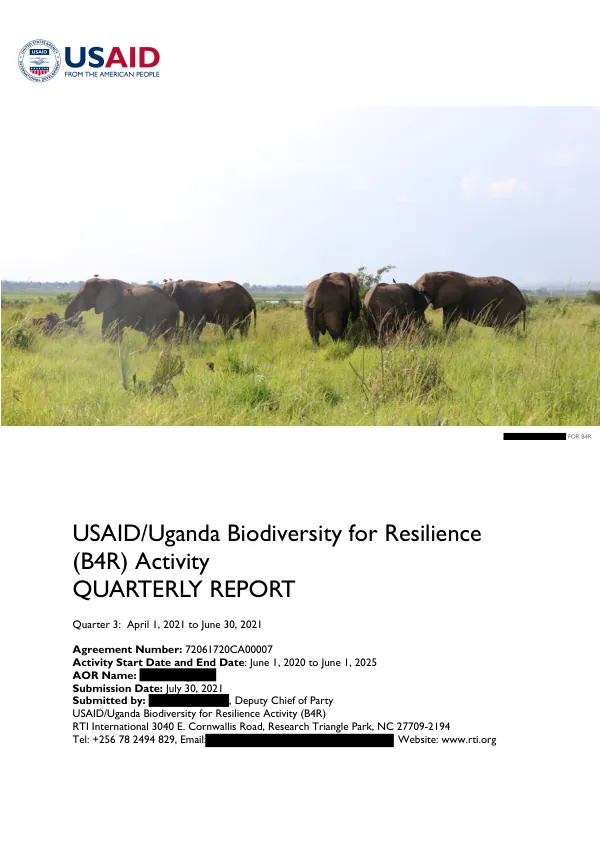
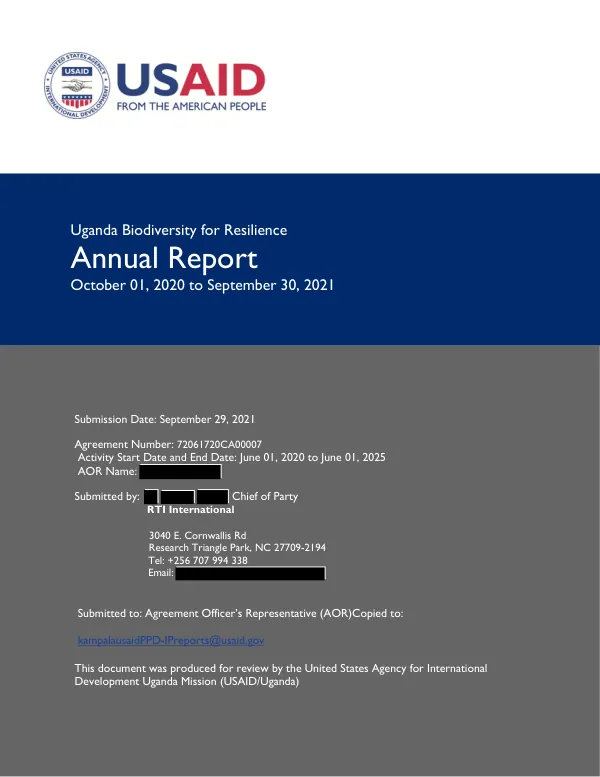
Uganda Biodiversity for Resilience Annual Report October 01, 2020 to September 30, 2021
Sign inAFRICAN WILDLIFE FOUNDATION
Uganda Biodiversity for Resilience Annual Report October 01, 2020 to September 30, 2021
The USAID/Uganda Biodiversity for Resilience Activity is a 5-year initiative aimed at conserving and managing biodiversity in target ecosystems for lasting environmental and economic sustainability.
2021 · 48 pages
Sign in to readA free account is required to download.
Abstract
The activity is designed to achieve three interrelated outcomes: linking economic, financial, and social investments to conservation; establishing governance arrangements that benefit biodiversity and enable communities to benefit from it; and strengthening the Government of Uganda's sustainable management of targeted protected areas and biodiversity adjacent to these areas. The activity will be implemented in three distinct geographic areas: the Kidepo Valley National Park area, the Murchison Falls National Park area, and the Lake Mburo National Park area. These areas are characterized by unique biodiversity and ecosystem services that are critical to the livelihoods of local communities. The activity will engage with local communities, the private sector, and government institutions to promote sustainable land-use practices, conserve wildlife, and enhance ecosystem services. Implementation of the activity will focus on several key interventions, including the establishment of community conservancies, the promotion of sustainable agriculture practices, and the development of market-based incentives for conservation. The activity will also support the development of governance arrangements that benefit biodiversity, including the establishment of collaborative forest management groups and the strengthening of protected area management. The activity will be implemented by a consortium of partners, including RTI International, African Wildlife Foundation, Conservation Through Public Health, and Viamo. The Uganda Wildlife Authority and the National Forestry Authority will serve as major counterpart organizations, providing critical support to the activity's implementation. The activity's monitoring, evaluation, and learning plan will be implemented through a collaborative approach, involving all partners and stakeholders. The plan will focus on tracking progress against the activity's outcomes and indicators, as well as identifying lessons learned and best practices that can be shared with other stakeholders. The activity's reporting period is from October 1, 2020, to September 30, 2021. During this period, the activity made significant progress in implementing its interventions and achieving its outcomes. Key highlights from the reporting period include the establishment of several community conservancies, the promotion of sustainable agriculture practices among local communities, and the development of market-based incentives for conservation. The activity's leadership development component focused on building the capacity of local communities and government institutions to manage and conserve biodiversity. This included the training of conservation animal health workers, the development of standard operating procedures for protected area management, and the establishment of a collaborative forest management group. The activity's environmental compliance component focused on ensuring that all interventions were implemented in accordance with environmental regulations and standards. This included the development of an environmental mitigation and monitoring plan, the implementation of measures to prevent human-wildlife conflict, and the monitoring of environmental impacts. The activity's award-specific reporting requirements included the submission of quarterly and annual reports to USAID, as well as the provision of information on the activity's progress and outcomes. The activity's management and administrative issues were addressed through regular meetings with the implementing partner and the USAID mission. The activity's planned activities for the next year include the continuation of community conservancy establishment, the promotion of sustainable agriculture practices, and the development of market-based incentives for conservation. The activity will also focus on strengthening the governance arrangements that benefit biodiversity, including the establishment of collaborative forest management groups and the strengthening of protected area management.