AFRICAN WILDLIFE FOUNDATION
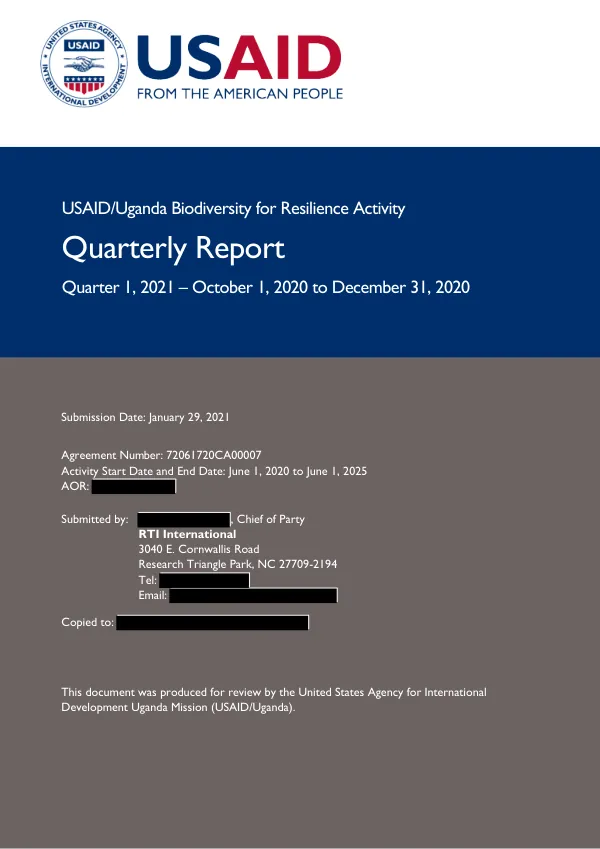
USAID/Uganda Biodiversity for Resilience Activity Quarterly Report
The USAID/Uganda Biodiversity for Resilience Activity is a 5-year initiative aimed at conserving and managing biodiversity in target ecosystems for lasting environmental and economic sustainability and increased community and household resilience.
2021 · 32 pages
Sign in to readA free account is required to download.
Abstract
The goal will be achieved through three interrelated outcomes: linking economic, financial, and social investments to conservation; establishing governance arrangements that benefit biodiversity and enable communities to benefit from it; and strengthening the Government of Uganda's sustainable management of targeted protected areas and biodiversity adjacent to protected areas. The activity is initially prioritizing the conservation of key biodiversity in four primary geographies: the Karenga Community Wildlife Area near Kidepo Valley National Park, including the Central Forest Reserves of Nyagea Napore, Rom, Timu, Lwala, and Morungole; the Murchison Community Conservancy near Murchison Falls National Park; the Rurambira Conservancy near Lake Mburo National Park; and the Budongo Central Forest Reserve. The activity may expand to the Queen Elizabeth National Park and Kalinzu Central Forest Reserve areas in the future, should resources allow. The activity's Year 1 work plan and Activity Monitoring, Evaluation, and Learning Plan (AMELP) were finalized and approved during the first quarter of Fiscal Year 2021. Many activities were started and were still in progress at the end of the quarter. The indicator targets are annual targets, and in some cases, do not have any targets for Year 1. The reported results to-date cover progress made at the Sub-Intermediate Result (IR) level as per USAID's quarterly report template. The USAID/Uganda Biodiversity for Resilience Activity has two goal-level indicators and two cross-cutting indicators on Gender, Youth, and Community Inclusion at the IR level. All four of these indicators will be reported in the FY21 annual report and are not included in this quarterly report. The activity's progress is being monitored and evaluated through the AMELP, which will provide evidence of progress towards achieving the goal. The activity's implementation progress is being tracked through the AMELP, which outlines the activities, indicators, and targets for the first year. The activity's progress is being reported in quarterly reports, which will provide updates on the implementation status, progress narrative, and other relevant information. The activity's leadership development, management and administrative issues, planned activities for the next quarter, and environmental compliance are also being addressed. The activity has established partnerships with various organizations, including the African Wildlife Foundation, Conservation Through Public Health, and Viamo, to support the conservation of biodiversity in the target ecosystems. The activity is also working with the Government of Uganda, the National Forestry Authority, and the Uganda Wildlife Authority to strengthen the sustainable management of protected areas and biodiversity adjacent to protected areas. The activity's financial management is being reported in the quarterly reports, which will provide updates on the expenditure, income, and other financial information. The activity's environmental compliance is being monitored and reported in the quarterly reports, which will provide updates on the environmental impact of the activity's implementation. The activity's success stories are being documented and reported in the quarterly reports, which will provide updates on the progress made towards achieving the goal. The activity's lessons learned and best practices are also being documented and reported in the quarterly reports, which will provide updates on the implementation of the activity. The activity's geographic coverage includes the four primary geographies mentioned earlier, which are the Karenga Community Wildlife Area, the Murchison Community Conservancy, the Rurambira Conservancy, and the Budongo Central Forest Reserve. The activity may expand to the Queen Elizabeth National Park and Kalinzu Central Forest Reserve areas in the future, should resources allow. The activity's timeframes are from June 1, 2020, to June 1, 2025, with quarterly reports being submitted to USAID/Uganda. The activity's recommendations are being made based on the progress made towards achieving the goal, and the activity's future plans are being developed based on the lessons learned and best practices documented in the quarterly reports.