RTI INTERNATIONAL
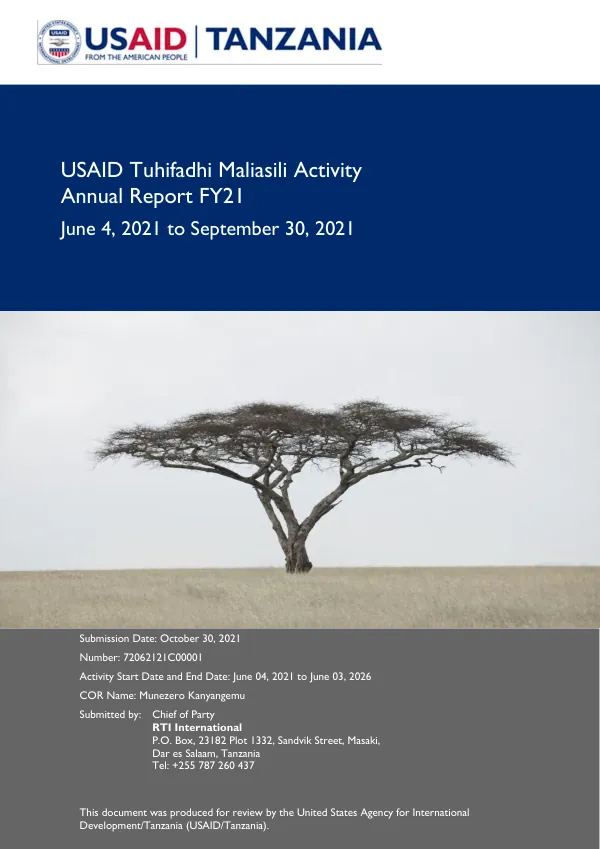
USAID Tuhifadhi Maliasili Activity Annual Report FY21
The USAID Tuhifadhi Maliasili Activity is a five-year initiative aimed at addressing dynamics that threaten habitat connectivity and the long-term persistence of biodiversity in Tanzania.
2021 · 24 pages
Sign in to readA free account is required to download.
Abstract
The Activity is being implemented by RTI International, with a budget of $30.5 million, and is expected to run from June 2021 to June 2026. The primary objective of the Activity is to strengthen government and civil society capacity for biodiversity conservation in Tanzania. The Activity is organized around three Intermediate Results (IR): IR1, which focuses on building institutional capacities of both public and private stakeholders; IR2, which aims to increase private sector engagement in conservation and Natural Resources Management (NRM); and IR3, which seeks to strengthen the policy and regulatory framework for conservation and NRM. These interventions are designed to reduce threats to biodiversity in Tanzania while moving Tanzanian institutions further toward self-reliance. The Activity is being implemented in six different corridors across Tanzania, including the Kwakuchinja Wildlife Corridor, Tarangire - Simanjiro Plains, Kigosi Moyowosi - Uvinza Corridor, Nyerere Selous - Udzungwa Corridor, Amani - Nilo Corridor, and Pemba Channel Conservation Area. These corridors are critical habitats for various species of plants and animals, and the Activity aims to protect and conserve these ecosystems. The Activity will incorporate a series of interventions, including farmer training programs, infrastructure development, and market linkage facilitation, to support and strengthen government and civil society capacity for biodiversity conservation. The interventions will also focus on increasing private sector engagement in conservation and NRM, and strengthening the policy and regulatory framework for conservation and NRM. The Activity has identified several key stakeholders, including the Government of Tanzania, non-governmental organizations (NGOs), and industry associations. The Activity will work closely with these stakeholders to build their capacity and increase their engagement in biodiversity conservation efforts. The Activity is expected to have a significant impact on biodiversity conservation in Tanzania, and will contribute to the country's efforts to achieve its conservation goals. The Activity will also provide opportunities for Tanzanians to engage in conservation efforts and develop their skills and knowledge in this area. The Activity's progress will be monitored and evaluated regularly, and the results will be used to inform future conservation efforts. The Activity will also provide opportunities for learning and sharing best practices in biodiversity conservation, and will contribute to the development of a more sustainable and resilient conservation sector in Tanzania. The Activity's geographic coverage includes six different corridors across Tanzania, and the Activity will work closely with local communities, government agencies, and other stakeholders to implement its interventions. The Activity's reporting period is from June 2021 to September 2021, and the Activity's next reporting period will cover the period from October 2021 to March 2022. The Activity's budget is $30.5 million, and the Activity will be implemented over a period of five years. The Activity's prime implementing partner is RTI International, and the Activity has several subcontractors and grantees, including Trade Record Analysis of Flora and Fauna in Commerce (TRAFFIC), Southern Tanzania Elephant Program (STEP), and Journalist Environmental Association of Tanzania (JET).