MINISTRY OF HEALTH
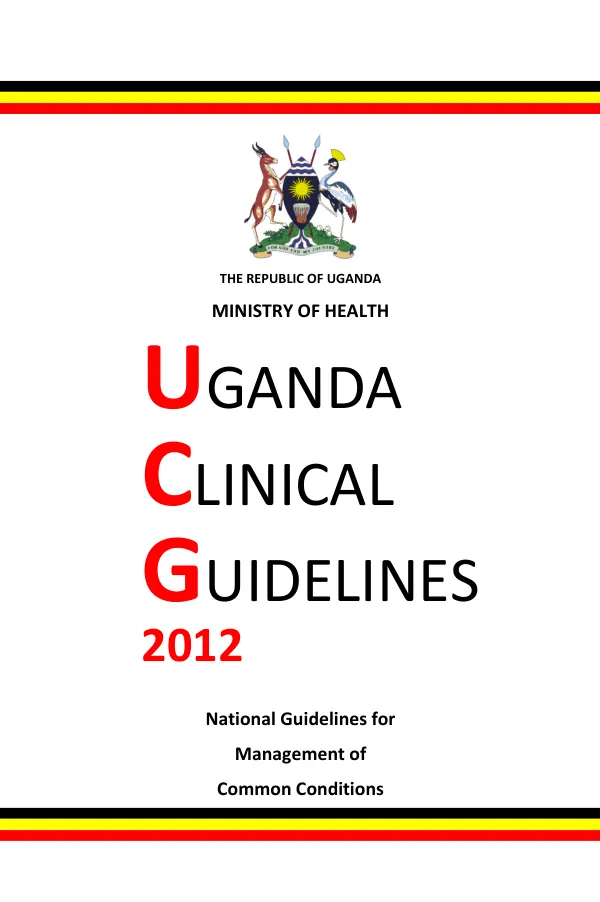
Uganda Clinical Guidelines UCG 2012
The Uganda Clinical Guidelines 2012 are a comprehensive document published by the Ministry of Health, Uganda.
2012 · 777 pages
Sign in to readA free account is required to download.
Abstract
The guidelines provide national standards for the management of common conditions in Uganda. The document is a revised edition, first published in 2003, with subsequent reprints in 2004 and 2005, and revised in 2010 and 2012. The guidelines are organized into 25 chapters, covering a wide range of conditions, including infections, parasitic diseases, respiratory diseases, gastrointestinal diseases, injuries and trauma, endocrine system disorders, and more. Each chapter provides detailed information on diagnosis, treatment, and management of the respective condition. The guidelines emphasize the importance of evidence-based practice and recommend the use of standardized treatment protocols. The document also includes information on prescribing guidelines, essential medicines, and health worker safety and universal hygiene precautions. The guidelines are intended for use by healthcare workers in Uganda, including doctors, nurses, and other healthcare professionals. The document is a valuable resource for healthcare providers, policymakers, and researchers working in Uganda. The guidelines cover a range of topics, including the management of common conditions such as malaria, tuberculosis, and HIV/AIDS. The document also provides information on the use of antiretroviral therapy, the management of opportunistic infections, and the prevention of mother-to-child transmission of HIV. The guidelines are based on the latest scientific evidence and are consistent with international standards and guidelines. The document is a critical resource for improving the quality of healthcare in Uganda and reducing the burden of disease in the country. The guidelines are organized into several sections, including an introduction, a foreword, and a preface. The introduction provides an overview of the guidelines and their purpose, while the foreword highlights the importance of the guidelines in improving healthcare in Uganda. The preface provides information on the development of the guidelines and the contributors to the document. The guidelines are written in a clear and concise manner, making them accessible to a wide range of healthcare professionals. The document includes a glossary of terms, an index of conditions, and an index of medicines, making it a valuable resource for healthcare providers. The guidelines are a critical resource for improving the quality of healthcare in Uganda and reducing the burden of disease in the country. The document provides a comprehensive framework for the management of common conditions and is a valuable resource for healthcare providers, policymakers, and researchers working in Uganda.