KPMG
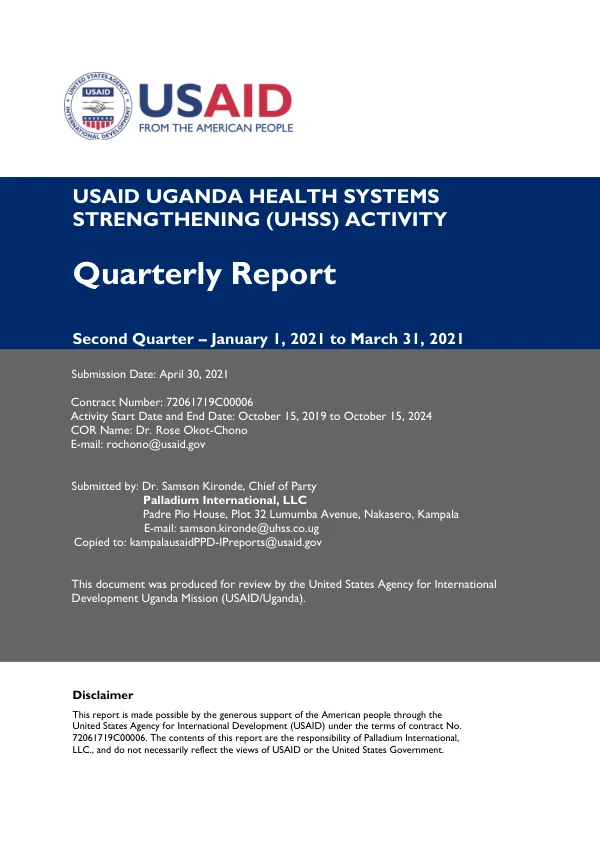
USAID Uganda Health Systems Strengthening (UHSS) Activity Quarter Two Report
The USAID Uganda Health Systems Strengthening (UHSS) Activity is a five-year project aimed at improving the health systems in Uganda.
2021 · 46 pages
Sign in to readA free account is required to download.
Abstract
The activity began on October 15, 2019, and is set to end on October 15, 2024. The project is implemented by Palladium International, LLC, with a contract number of 72061719C00006. The activity has a geographic coverage of 77 USAID-supported districts in the five regions where the RHITES projects are based. The UHSS Activity has three main results: Improved Governance Leadership and Accountability (GLA) for Results, Increased Availability and Improved Management of Key Health Systems Resources, and Strengthened Community Systems for Quality Health Services. The activity is implemented in partnership with various organizations, including the Uganda Ministry of Health, Ministry of Local Government, Ministry of Finance, Planning and Economic Development, and 77 District Local Governments. The quarterly report for the second quarter of program year 2, covering the period from January 1, 2021, to March 31, 2021, highlights the progress made towards achieving the activity's results. The report notes that the activity has made significant progress in improving governance leadership and accountability, with the development of a performance dashboard for the Ministry of Health. The report also highlights the activity's efforts to increase the availability and management of key health systems resources, including the implementation of the Health Financing Harmonization and Transition Plan. In terms of strengthened community systems for quality health services, the report notes that the activity has made progress in improving the management of health unit management committees and the implementation of comprehensive support supervision. The report also highlights the activity's efforts to improve the management of human resources for health, including the implementation of a human resources for health inventory tool. The report also provides an update on the activity's monitoring, evaluation, and learning efforts, including the implementation of a knowledge management and communication strategy. The report notes that the activity has made progress in implementing the guiding principles for the activity, including the principles of governance, accountability, participation, and performance. The report also highlights the challenges faced by the activity, including the need to improve the management of health financing and the need to strengthen the capacity of district local governments. The report notes that the activity is working to address these challenges through a range of interventions, including the implementation of a health financing harmonization and transition plan and the provision of technical assistance to district local governments. Overall, the quarterly report for the second quarter of program year 2 provides an update on the progress made towards achieving the activity's results and highlights the challenges faced by the activity. The report provides a comprehensive overview of the activity's efforts to improve the health systems in Uganda and highlights the need for continued support to achieve the activity's goals. The activity has made significant progress in improving governance leadership and accountability, with the development of a performance dashboard for the Ministry of Health. The dashboard provides a comprehensive overview of the ministry's performance and is expected to improve the ministry's accountability and transparency. The activity has also made progress in increasing the availability and management of key health systems resources, including the implementation of the Health Financing Harmonization and Transition Plan. The plan aims to improve the management of health financing and is expected to increase the availability of resources for health services. The activity has also made progress in implementing the guiding principles for the activity, including the principles of governance, accountability, participation, and performance. The activity has also made progress in implementing a knowledge management and communication strategy, which aims to improve the sharing of knowledge and best practices among stakeholders. The activity has also made progress in improving the management of health services, including the implementation of a health services-related calls handled by the Ministry of Health call center. The activity has also made progress in improving the management of health information systems, including the implementation of a health management information system. The activity has also made progress in improving the management of human resources for health, including the implementation of a human resources for health inventory tool. The activity has also made progress in improving the management of health financing, including the implementation of a health financing harmonization and transition plan. The activity has also made