USAID DEC
Understanding the groundwater-level fluctuations for better management of groundwater resource: A case in the Johannesburg region
Sign inUSAID DEC
Understanding the groundwater-level fluctuations for better management of groundwater resource: A case in the Johannesburg region
Groundwater-level fluctuations in the Johannesburg region are influenced by a combination of anthropogenic and natural processes.
2018 · 6 pages
Sign in to readA free account is required to download.
Abstract
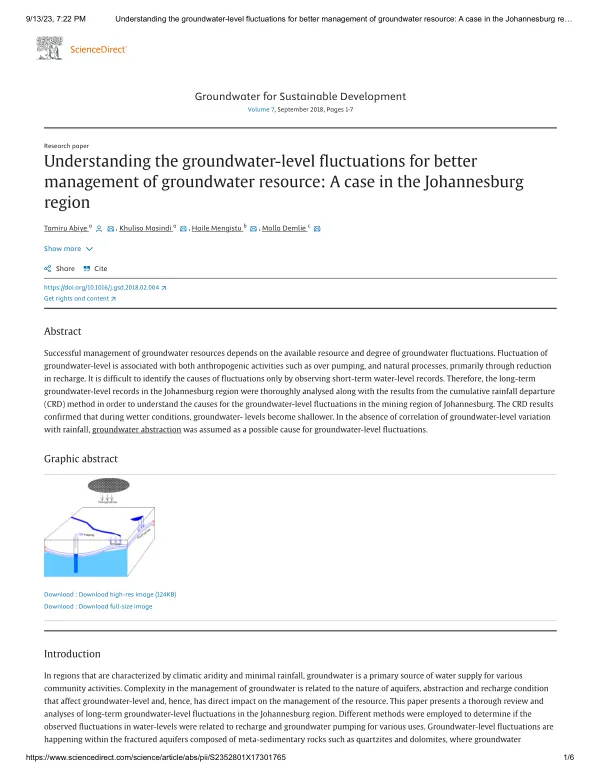
The region's fractured aquifers, composed of meta-sedimentary rocks such as quartzites and dolomites, are primarily controlled by fractures and weathering zones. Groundwater occurrence is controlled by these fractures and weathering zones, through which groundwater flow and storage take place. Numerous boreholes tap fractured and weathered aquifers for domestic, industrial, mining, and agricultural activities. The development of groundwater resources from these aquifers has been regarded as very important for economic growth in the region due to its availability at shallow depth and scarcity of surface water sources often characterized by poor water quality. Boreholes that tap fractured crystalline aquifers reach depths of about 300 meters below ground level. Over a century of gold mining activity in the region has put groundwater under stress from over-pumping to sustain underground mining operations. Dewatering activities for underground mining operations have decreased groundwater-level drastically for a long period of time and in many instances dried up surrounding springs. Mine-related pumping has been suspected to affect groundwater users and groundwater-dependent ecosystems in the region due to the lowering of groundwater-levels. Long-term groundwater-level records in the Johannesburg region were analyzed along with the results from the cumulative rainfall departure (CRD) method to understand the causes of groundwater-level fluctuations. The CRD results confirmed that during wetter conditions, groundwater-levels become shallower. In the absence of correlation of groundwater-level variation with rainfall, groundwater abstraction was assumed as a possible cause for groundwater-level fluctuations. Studies across the world have indicated that most frequent groundwater-level fluctuations are related to over-pumping of groundwater. For example, in the USA, the decline of the potentiometric surface of the Ozark aquifer in Springfield, Missouri, was intensified during the 1980s as a result of intensive pumping. Large groundwater abstraction has also caused a linear to exponential drop in groundwater-level and substantial aquifer dewatering in Dhaka, Bangladesh. The Johannesburg region is characterized by high water demand, particularly for industrial and irrigation purposes, which necessitates groundwater withdrawal. Mining companies also require water for reclamation of abandoned tailings dams. High water demand and deep mining activity are believed to play a significant role in lowering the groundwater-level in the region. Sinkholes often develop in dolomites, where water tables were lowered by pumping to maintain dry working conditions in mines. The Standard Precipitation Index and Earth models have been used to conclude that the observed groundwater-level fluctuation in South Africa is attributed to rainfall variation due to climate change. However, boreholes around the Witwatersrand mining areas, particularly around the city of Johannesburg, were excluded from the model simulation. The El Nino event related to the Southern Oscillation (ENSO) periods could also influence rainfall occurrence over much shorter intervals, which South Africa is undergoing since 2015.