USAID DEC
United States Foreign Assistance
The United States Foreign Assistance Reform aims to strengthen strategic coherence among overall foreign policy objectives and development requirements.
2009 · 14 pages
Sign in to readA free account is required to download.
Abstract
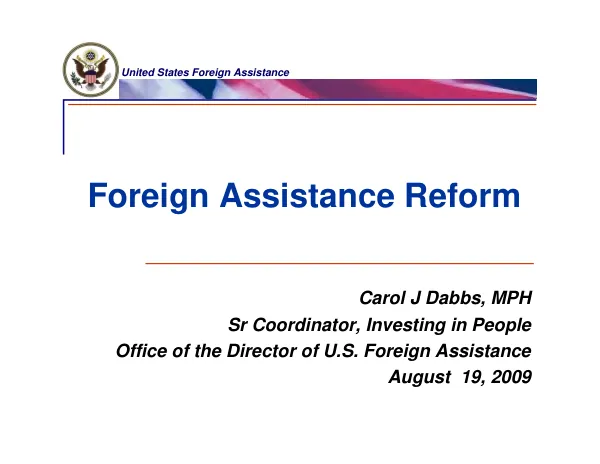
Established in 2006, the Director of U.S. Foreign Assistance (DFA) reports directly to the Secretary of State, enhancing the Secretary's ability to oversee and coordinate all U.S. foreign assistance. The DFA's responsibilities include developing and defending integrated foreign assistance budgets, strengthening planning, oversight, accountability, and performance of foreign assistance funds, addressing unbudgeted priorities during the year, and providing guidance for foreign assistance delivered through other agencies or entities of the U.S. government. The DFA has achieved several key accomplishments, including increased transparency and coordination in the allocation of foreign assistance resources, creation of a Foreign Assistance Standardized Program Structure, more effective prioritization of resources to ensure that U.S. policy objectives are met, and improved access to information. The DFA focuses on five priority objectives, including developing and defending integrated foreign assistance budgets, strengthening planning, oversight, accountability, and performance of foreign assistance funds, addressing unbudgeted priorities during the year, providing guidance for foreign assistance delivered through other agencies or entities of the U.S. government, and improving access to information. The United States Foreign Assistance Framework consists of functional objectives, areas, and elements. The framework includes five functional objectives: Peace and Security, Governing Justly and Democratically, Investing In People, Economic Growth, and Humanitarian Assistance. Investing In People is a key objective, which includes three areas: Health, Education, and Social & Economic Services & Protection for Vulnerable Populations. Education is an area within Investing In People, which includes two elements: Basic Education and Higher Education. The Foreign Assistance Reform has also established a Standardized Program Structure and Definitions. This structure provides a common language, established structure, and precise, mutually exclusive definitions. Examples of the structure include the objective of Investing In People, with the area of Education, and the element of Basic Education, which includes a sub-element of Learning for Out-of-School Youth. The objective of Economic Growth includes the area of Private Sector Competitiveness, with the element of Workforce Development, which includes a sub-element of Technical/Vocational Training for Employment. The Planning, Budgeting, and Reporting Cycle is a critical component of the Foreign Assistance Reform. At any point in time, the U.S. government is reporting, implementing, justifying, and planning on four different fiscal years. This cycle involves reporting on FY2008 results, implementing the FY2009 budget, justifying the FY2010 budget to Congress, and planning the FY2011 budget. The Operational Plan (OP) is an essential part of this cycle, which is an Operating Unit's proposal for the use of new resources for a single fiscal year. Once approved by the DFA, the OP is an agreement between the DFA and the Operating Unit on the use of the resources.