USAID DEC
Untitled Document
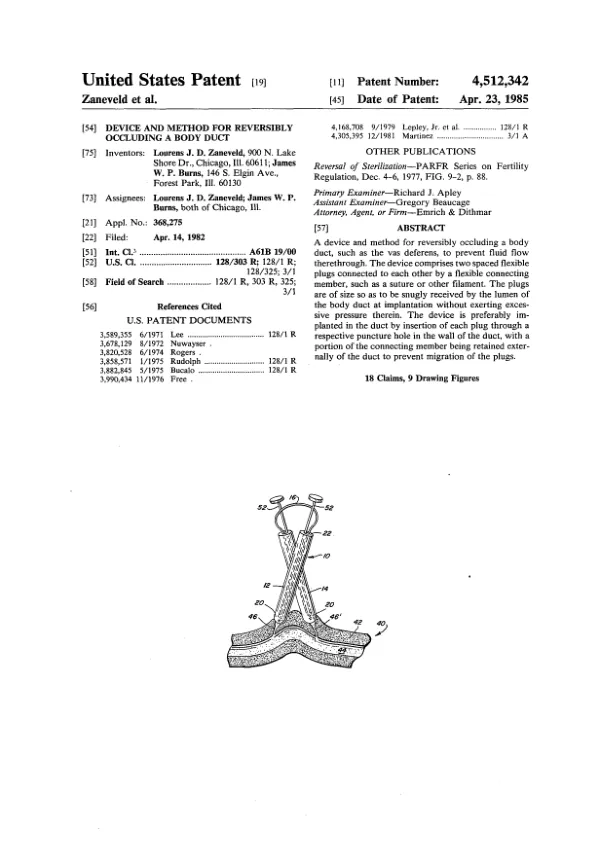
The device and method for reversibly occluding a body duct, such as the vas deferens, is designed to prevent fluid flow through the duct.
8 pages
Sign in to readA free account is required to download.
Abstract
The device comprises two spaced flexible plugs connected to each other by a flexible connecting member, such as a suture or other filament. The plugs are of a size that allows them to be snugly received by the lumen of the body duct at implantation without exerting excessive pressure. The device is preferably implanted in the duct by insertion of each plug through a respective puncture hole in the wall of the duct, with a portion of the connecting member being retained externally of the duct to prevent migration of the plugs. The major portion of the connecting member extending between the plugs is retained externally of the duct to aid in subsequent removal of the device. In a preferred embodiment, the portion of the body duct retaining the plugs is loosely wrapped with body tissue to prevent dilation of the duct around the plugs. The device is designed to be simple in construction and readily surgically implantable. Neither implantation nor the continued presence of the device in the body duct alters the histology of the vas. The device is especially applicable to reversible occlusion of the vas deferens in order to achieve male sterilization. According to the method of the present invention, the body duct is blocked at two axially spaced positions without sectioning of the duct by insertion into the duct lumen two plugs of soft, flexible, biocompatible material. The plugs are preferably elongate and are of substantially luminal cross-sectional size at the time of implantation and are connected by a flexible member, such as a suture or other filament. The plugs are inserted into the duct lumen through the duct wall, and the major portion of the connecting member extending between the plugs is retained externally of the duct to prevent migration of the plugs and to aid in subsequent removal of the device. The dimensions of the device and the component elements will depend upon the dimensions of the body duct to be occluded. Each plug is preferably generally cylindrical in shape with an outer diameter of substantially luminal dimension at the time of implantation. Elongation of the plugs is not critical, and there is no minimum length requirement. The connecting element need not comprise a single element but may comprise separate elements attached to each plug, respectively, to be attached to each other after implantation of the plugs. The device is designed to be reversible, and the sterilization procedure can be reversed by simple removal of the device. The device is also designed to be non-invasive and to cause minimal damage to the surrounding tissue. The device is particularly useful for male sterilization and can be used in conjunction with other methods of contraception. The device and method for reversibly occluding a body duct have several advantages over existing methods. The device is simple in construction and readily surgically implantable, and neither implantation nor the continued presence of the device in the body duct alters the histology of the vas. The device is especially applicable to reversible occlusion of the vas deferens in order to achieve male sterilization.