DELOITTE CONSULTING, LLP
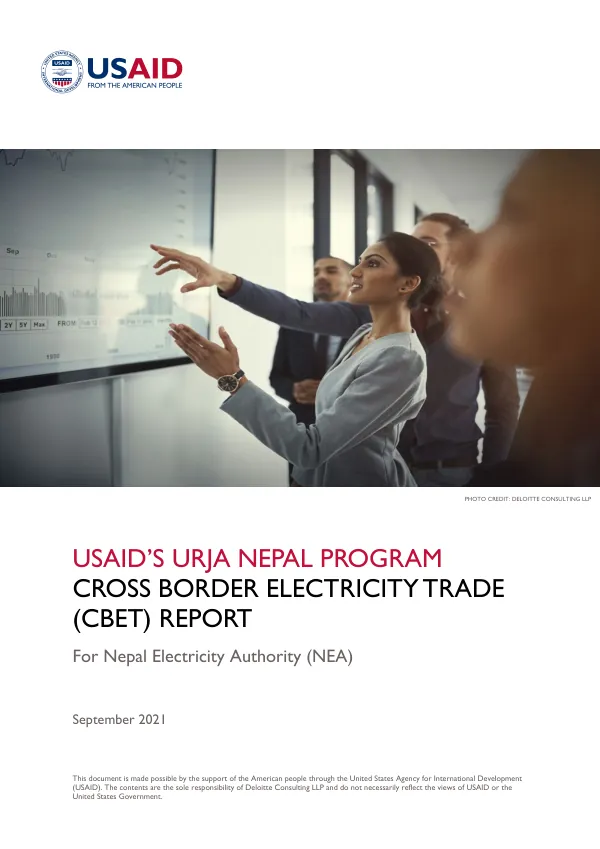
Urja Nepal Project Gender Equality and Social Inclusion (GESI) Analysis Report
The Urja Nepal project aims to create a financially viable electricity sector in Nepal, providing affordable, reliable, and secure power, and enabling private investment in the Nepali market.
2021 · 23 pages
Sign in to readA free account is required to download.
Abstract
The project's overall goal is to improve utility performance and relevant sector policies, deploy advanced energy systems, increase private sector engagement, and advance cross-border energy trade between Nepal and its neighbors. Nepal's constitution recognizes equal rights for all citizens, and the country is legally committed to gender equality and social inclusion (GESI). Despite these efforts, Nepali women and minorities continue to face significant barriers in terms of meaningful participation and representation in various arenas. Women and minorities are underrepresented in the energy sector workforce, have limited access to education and vocational training, leadership, and networking opportunities, and face numerous challenges as entrepreneurs and developers. To address these systemic issues, the Urja Nepal project will strive to be gender sensitive and inclusive, providing opportunities for both women and minorities, and supporting policies and activities aimed at equitable inclusion. The project will consider how interventions might impact women and minorities' participation in the energy sector value chain and build the capacity of partners to address gender and minority inequalities within their spheres of influence. The GESI analysis development process involved a review of relevant literature and a series of interviews with stakeholders, including implementors of energy and GESI programs, project developers, women active in the energy sector, GESI experts, and Urja Nepal project staff. The analysis identified key challenges faced by women and minorities, including limited or no energy access, which disproportionately affects women as main caregivers in households. The project's approach to integrating GESI concerns involves four objectives: improving utility performance and relevant sector policies, deploying advanced energy systems, increasing private sector engagement, and advancing cross-border energy trade between Nepal and its neighbors. The project will consider how interventions might impact women and minorities' participation in the energy sector value chain and build the capacity of partners to address gender and minority inequalities within their spheres of influence. The GESI integration plan outlines activities aligned with project objectives, including training programs for women and minority entrepreneurs, capacity building for government and private sector partners, and social mobilization and empowerment initiatives. The plan also identifies high-level entry points for GESI integration, including policy and regulatory frameworks, project design and implementation, and monitoring and evaluation. The project will be implemented in collaboration with various stakeholders, including government agencies, private sector companies, and civil society organizations. The project's success will be monitored and evaluated through regular progress reports and assessments, which will inform adjustments to the project's approach and activities as needed. The GESI analysis report provides recommendations on how GESI concerns can be meaningfully incorporated across Urja Nepal's various components. The report outlines a methodology and approach for integrating GESI concerns, defines high-level entry points, and outlines activities aligned with project objectives. The report will be updated periodically during the course of project implementation as appropriate. The project's GESI specialist will play a critical role in ensuring that GESI concerns are integrated into project design and implementation. The specialist will work closely with project staff, partners, and stakeholders to identify and address GESI challenges and opportunities, and to ensure that project activities are aligned with GESI objectives. The project's management considerations for GESI integration include addressing GESI within the Urja Nepal team, monitoring results of activities, and ensuring that GESI concerns are integrated into project design and implementation. The project will also establish a GESI working group to provide a platform for stakeholders to share experiences, best practices, and lessons learned on GESI integration. The project's implementation will be guided by a set of key performance indicators (KPIs) that will be used to monitor progress towards GESI objectives. The KPIs will include metrics such as the number of women and minority entrepreneurs trained, the number of women and minority leaders in key positions, and the level of participation of women and minorities in project activities. Overall, the Urja Nepal project aims to create a more inclusive and equitable energy sector in Nepal, where women and minorities have equal opportunities to participate and benefit from energy access and development. The project's GESI integration plan provides a framework for achieving this goal, and the project's management considerations and implementation approach will ensure that GESI concerns are integrated into project design and implementation.
Related documents