USAID
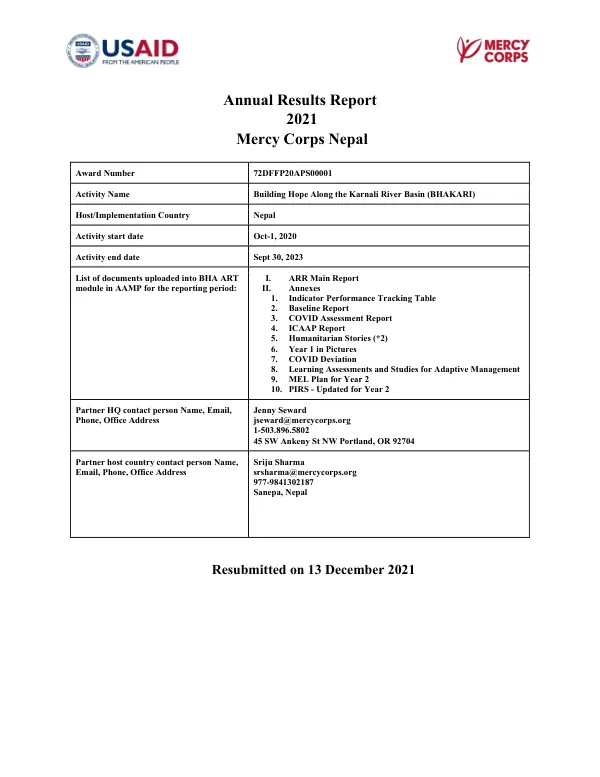
Annual Results Report FY21 Building Hope Along Karnali River Basin 72DFFP20APS00001
The BHAKARI Activity, managed by Mercy Corps Nepal, is a Multi-Year Emergency program supported by USAID's Bureau for Humanitarian Assistance (BHA).
2021 · 28 pages
Sign in to readA free account is required to download.
Abstract
The program focuses on increasing long-term food security while responding to short-term emergency shocks through an integrated, multi-sectoral approach with a strong emphasis on gender and social inclusion. Key sectors include disaster risk reduction, integrated agriculture, productive water, and emergency assistance, and are implemented in partnership with six district-level implementing partners and three national-level technical partners. In FY21, the BHAKARI team laid the groundwork for programmatic implementation, including opening and staffing new offices, securing Government of Nepal approval, and rolling out a community selection process. The program also formed various groups and committees, enabling a solid base to support fast-paced implementation. However, COVID-19 resulted in delays in achieving some Year one targets. The program successfully reached 37,242 unique individuals through Agriculture, DRR, Productive Water, Emergency, SBCC, and GESI interventions, exceeding the year one target by 106 percent. A GESI first approach was applied across all components, prioritizing and strengthening inclusion and empowerment of underrepresented groups in program activities. Year one saw an increased number of women and disadvantaged groups in decision-making positions and changes in knowledge, practices, and attitudes regarding GESI concepts. The BHAKARI team conducted an informal analysis to understand the experience of women and disadvantaged groups in decision-making roles, including participation. Key findings include that community groups have been receptive to women and individuals from disadvantaged groups moving into leadership roles, and that women and those from disadvantaged groups have shared that taking on a decision-making role has allowed them to bring a broader range of issues to these groups. The program kicked off with the Integrated Community Assessments and Action Planning (ICAAP) process in all 252 communities to identify and prioritize highly vulnerable households, groups, and communities who are frequently affected by recurrent natural hazards and may face food insecurity and water scarcity as a result. The assessment was key in identifying challenges of the program communities and served to inform program activities and interventions. The BHAKARI team has also conducted various activities to support the program's goals and objectives, including online training, orientations, and gathering in small groups. The program has also applied a GESI first approach across all components, prioritizing and strengthening inclusion and empowerment of underrepresented groups in program activities. The program's overall performance in FY21 was satisfactory, with the team successfully laying the groundwork for programmatic implementation and reaching a significant number of unique individuals through various interventions. However, the challenges posed by COVID-19 resulted in delays in achieving some Year one targets. The BHAKARI Activity has made significant progress in FY21, with a strong focus on gender and social inclusion, disaster risk reduction, integrated agriculture, productive water, and emergency assistance. The program has also demonstrated its ability to adapt to challenging circumstances, including COVID-19, and has made significant strides in reaching its target population. The program's future plans include continuing to explore meaningful participation and leadership as part of the Year 2 learning agenda, and providing formal training on relevant skills to support active and meaningful participation. The program will also continue to prioritize and strengthen inclusion and empowerment of underrepresented groups in program activities. The BHAKARI Activity has made significant contributions to the lives of the people in the Karnali River Basin, and its continued efforts will be crucial in addressing the challenges faced by the communities in the region. The program's commitment to gender and social inclusion, disaster risk reduction, integrated agriculture, productive water, and emergency assistance will be essential in achieving its goals and objectives. The program's geographic focus is on the Karnali River Basin in Nepal, with a strong emphasis on the districts of Surkhet and Jumla. The program's implementation is being carried out in partnership with six district-level implementing partners and three national-level technical partners, with close collaboration with the Government of Nepal. The program's timeframes are from October 1, 2020, to September 30, 2023, with a focus on achieving its Year one targets in FY21. The program's overall performance in FY21 was satisfactory, with the team successfully laying the groundwork for programmatic implementation and reaching a significant number of unique individuals through various interventions.
Related documents