USAID DEC
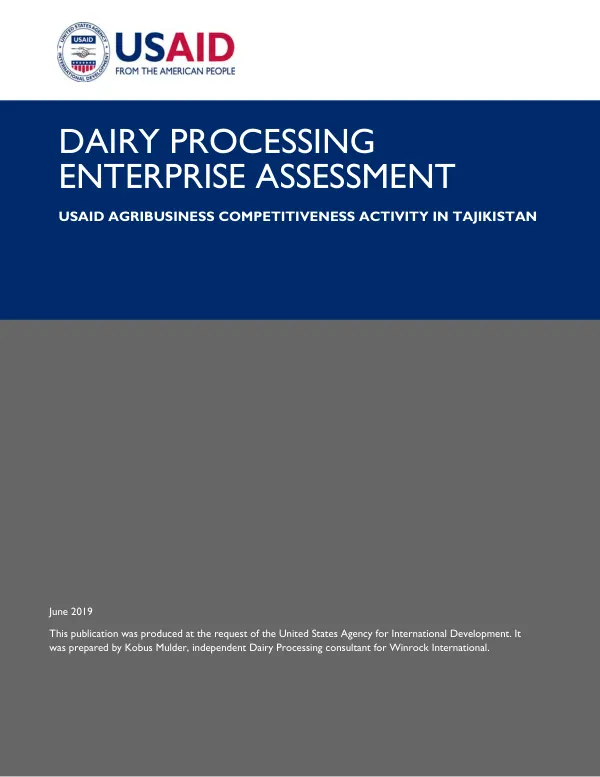
USAID Agribusiness Competitiveness Activity in Tajikistan: Dairy Processing Enterprise Assessment
Sign inWINROCK INTERNATIONAL FOUNDATION
USAID Agribusiness Competitiveness Activity in Tajikistan: Dairy Processing Enterprise Assessment
The USAID Agribusiness Competitiveness Activity in Tajikistan (ACAT) aims to expand and improve market systems in Tajikistan to increase employment opportunities and income for agribusinesses.
2019 · 49 pages
Sign in to readA free account is required to download.
Abstract
As part of this initiative, a dairy processing value addition expert conducted an assessment of dairy processing enterprises in Tajikistan from May 3 to 24, 2019. The assessment involved visits to seven dairy processing enterprises, including Cooperative "Tijorati Sorbon" in Yovon District, OJSC "Shiri Bokhtar" in Bokhtar District, OJSC "Osie+M" in Bokhtar District, LLC "Zarifa-2013" in Qubodiyon District, Cooperative "Nufuzi Vakhsh" in Vakhsh District, MP "Muzaffarov" in Pyanj District, and LLC Inter Market in Dushanbe. The expert also conducted visits to regional and national institutions, including the Khatlon Region Veterinary Diagnostic Laboratory, the Republic Center for Veterinary Diagnostics, the Livestock Institute and Center for Animal Biotechnology, and the Milk Producers Association. The assessment aimed to evaluate the current status of dairy processing capabilities and operational efficiencies, identify challenges and opportunities for improvement, and provide recommendations for each facility. The expert also aimed to select dairy products to be improved in terms of quality and/or recommend new products that could be produced locally. Cooperative "Tijorati Sorbon" is a processor that has started one year ago, processing 200 liters of milk per day. The processor receives milk from four suppliers, including three household farmers and one milk buyer. The milk is analyzed for butterfat, protein, and density using an Ekomilk milk analyzer, but the pH value cannot be read, and the titratable acidity is measured manually. The results show an average content of 3.66% butterfat and 2.90% protein, but water is added to the milk of some suppliers on various occasions. The average protein content is below international standards, and this issue will be discussed under general recommendations for the improvement of the Tajikistan dairy industry. The average temperature of milk on arrival is 19-24℃, indicating that the milk was not cooled after milking. This is normal, as household milk producers do not produce enough milk to warrant cooling equipment for the evening milk. The analyzes results of fresh milk are handled by a qualified laboratory technician who understands chemical processes. The assessment also highlighted the importance of milk quality and the need for dairy processors to improve their skills and equipment to produce high-quality dairy products. The expert recommended that dairy processors should focus on improving their milk collection and cooling systems, as well as their processing techniques and equipment. The expert also suggested that dairy processors should consider replacing milk buyers with more effective milk collection centers where milk could be cooled on arrival. The assessment provided specific recommendations for each facility, including Cooperative "Tijorati Sorbon", OJSC "Shiri Bokhtar", OJSC "Osie+M", LLC "Zarifa-2013", Cooperative "Nufuzi Vakhsh", MP "Muzaffarov", and LLC Inter Market. The expert also provided general recommendations for the improvement of the Tajikistan dairy industry, including the need to improve milk quality, processing techniques, and equipment, as well as the importance of milk collection and cooling systems. The assessment concluded that the dairy processing industry in Tajikistan has significant potential for growth and development, but it requires improvement in terms of milk quality, processing techniques, and equipment. The expert recommended that dairy processors should focus on improving their skills and equipment to produce high-quality dairy products and that the government and other stakeholders should provide support to the dairy processing industry to improve its competitiveness and sustainability.