USAID
USAID's Agribusiness Competitiveness Activity in Tajikistan (ACAT) Final Report
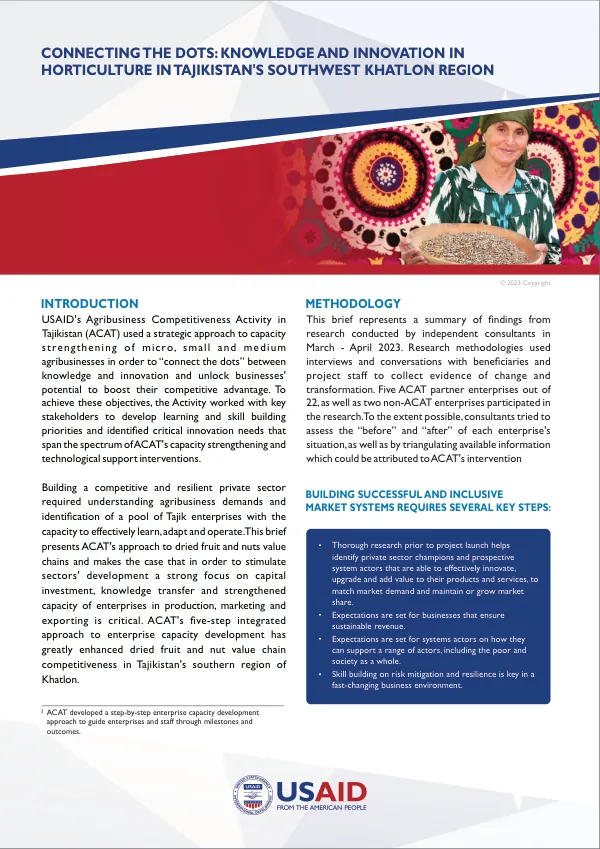
Building a competitive and resilient private sector in Tajikistan's Khatlon region required understanding agribusiness demands and identifying a pool of enterprises with the capacity to effectively learn, adapt, and operate.
2023 · 3 pages
Sign in to readA free account is required to download.
Abstract
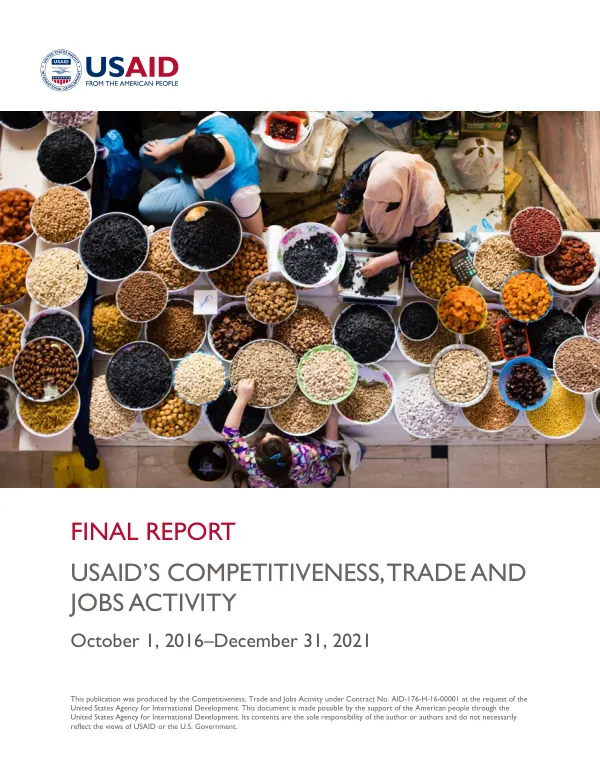
ACAT's approach to dried fruit and nuts value chains focused on capital investment, knowledge transfer, and strengthened capacity of enterprises in production, marketing, and exporting. ACAT's five-step integrated approach to enterprise capacity development enhanced dried fruit and nut value chain competitiveness in the Khatlon region. The Activity worked with key stakeholders to develop learning and skill-building priorities and identified critical innovation needs that spanned the spectrum of ACAT's capacity strengthening and technological support interventions. A step-by-step enterprise capacity development approach was developed to guide enterprises and staff through milestones and outcomes. Research conducted by independent consultants in March-April 2023 revealed several key findings. The focus on introducing ideas, brokering relationships, and fostering innovations at the enterprise level while addressing the local context and broader systemic change spurred an innovative facilitation approach with the potential to create additional value to businesses. ACAT's facilitation approach at the value chain and system levels created value for businesses, including domestic and international study tours, business-to-government meetings, and quarterly cluster meetings of all nut and fruit processing businesses. To compete in regional markets and gain a larger share of the domestic market, all fruit drying and nut processing enterprises diversified their product and service offerings, including a substantial increase in quality standards, improved packaging, and branding. ACAT took a firm-centered intervention approach that focused on the internal capacity of enterprises to help them become more customer-oriented. Through support on market research, technological enhancement, and product development, ACAT mentored 22 enterprises to apply improved technologies and management practices and facilitated linkages among value chain actors for development of high-value and value-added products. The fruit drying value chain in Tajikistan's Khatlon region was transformed as a result of partnership with ACAT. Enterprises in the value chain reported a transformation of their approach in doing business, improving the flow of information about supply and services, collaboration with package manufacturers, new commercial nodes, stronger customer feedback loops, and improved collaboration with government agencies. ACAT's approach in strengthening the value chain worked with enterprises as an entry point in building linkages among actors. Improved product quality was achieved through a customer-centric focus and understanding of available market opportunities. Enterprises now show a good level of understanding of the importance of product innovation and risk assessment. ACAT worked with horticulture actors to select products that have strong market potential and supported that selection with proper equipment through ACAT's Partnership Investment Fund. Technological innovation and technical skill-building offered by ACAT through hands-on mentoring was found to be a key factor in quality improvement. Access to new markets requires transparency, trust, and confidence. ACAT-partner enterprises showed a good level of understanding of their position in the market and potential opportunities, but also shared challenges they have encountered such as stringent customer demand for volume, high transportation costs, legal challenges, and unclear information about opportunities. ACAT sought to address lack of knowledge on how to access markets by introducing a course on marketing, followed by simulated negotiations of real-life cases. Financial gains and job creation were achieved through the use of cost-benefit tools provided by ACAT. All enterprises reported significant financial gains, from 18% to 200%. In addition, all interviewed enterprises made their own investments into the business, from funding working capital to investments in new facilities to accommodate the future expansion of business. On the operations side, the enterprises have adopted improved workplace policies, including adding jobs, increasing full-time employment, rationalizing wages, and standardizing safe working conditions.
Related documents