USAID
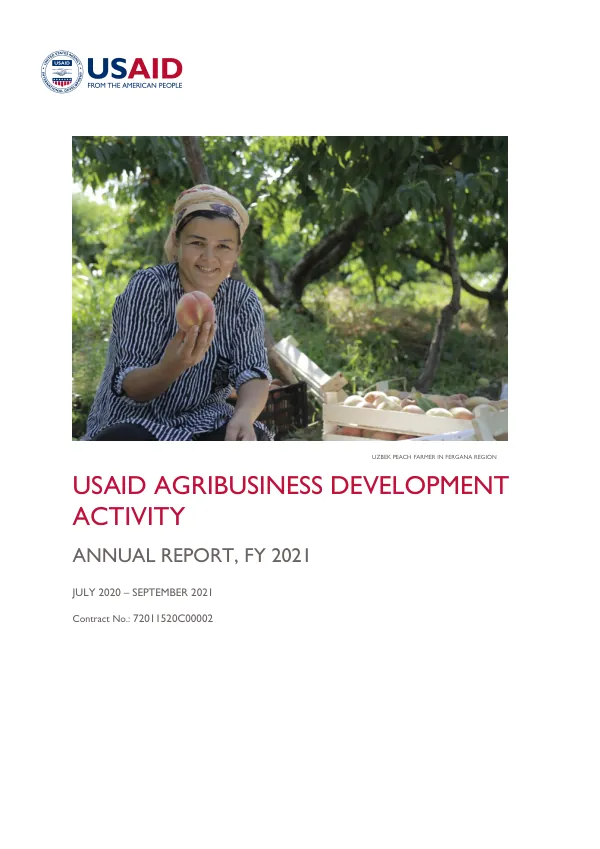
USAID Agribusiness Development Activity Quarterly Report FY2021, Q3
The USAID Agribusiness Development Activity is a five-year project that aims to increase the competitiveness of agribusinesses in Uzbekistan by introducing new value-added technologies and management practices.
2021 · 23 pages
Sign in to readA free account is required to download.
Abstract
The project follows a market systems development approach to achieve its objectives, which include empowering women and youth with skills and knowledge to secure skilled positions within agribusinesses and launch their own agribusinesses. During the reporting period, the Activity's market systems development team conducted online voice chats and field-based trainings on various topics, including cherry export management, orchard and vineyard management, and integrated pest management. The trainings aimed to empower agricultural producers with the skills and knowledge to produce, add value, and supply products that meet buyers' quality standards. The Activity organized 13 customized trainings focused on understanding buyers' quality standards, integrated pest and agribusiness management, production of grapes and other horticultural products, and exporting cherries for 418 agribusiness owners, farmers, and agricultural service providers. The trainings were conducted in the Bukhara and Kashkadarya regions, and the participants raised questions about the current challenges they are facing with postharvest handling, storage, market access, and the sale of cherries. The Activity also conducted six trainings in June on agribusiness development for 96 agribusiness owners, farmers, and members of the Businesswomen's Association of Uzbekistan and Fishery Association of Uzbekistan operating in the Bukhara and Kashkadarya regions. During the trainings, the MSD team emphasized the importance of understanding the quality requirements of buyers in their target markets and provided examples of how agribusinesses and farmers can manage production and add value to their harvested crops to supply buyers with a sufficient quantity of products that meet buyers' quality standards and delivery requirements. In addition, the Activity conducted four trainings on integrated pest management for greenhouse and open field crops, including how to identify the primary pests and diseases that attack crops and how to mitigate their impact on crops by properly using the correct plant protection solutions. A total of 220 farmers, extension agents, input suppliers, and plant protection specialists participated in the four trainings in the Khorezm and Karakalpakstan regions. The Activity also organized a training program in the Andijan and Fergana regions for 22 advanced grape farmers from the Khorezm, Navoiy, and Fergana regions. The training program aimed to improve the knowledge and skills of grape farmers in the production of high-quality grapes and to promote the export of grapes from Uzbekistan. The Activity's Agribusiness Development Fund was announced in June to aid agribusinesses and entrepreneurs to adopt new technologies and management practices, stimulate employment opportunities for women and youth, and boost the development of Uzbekistan's agritourism sector. The Activity will use the Fund to partner with agribusinesses and entrepreneurs in co-financing initiatives to add value to agricultural products and services, facilitate access to new markets, and generate increased sales, income, and employment. The Activity's baseline survey was launched in April as part of the Activity's Gender Equality and Social Inclusion assessment. The survey aimed to identify and implement interventions to promote women and youth employment and entrepreneurship. The Activity and partners conducted interviews with agribusiness owners and initiated focus group discussions and key informant interviews with unemployed adults and youth, and representatives of local governments, business associations, and non-governmental organizations. The Activity's partners, including Tashkent State Agrarian University, Andijan Institute for Agriculture and Agri-Technology, and Samarkand Institute of Veterinary Medicine, agreed to jointly improve two undergraduate courses and introduce two new graduate courses to improve curricula and target academic research to meet the needs of agribusinesses.