USAID DEC
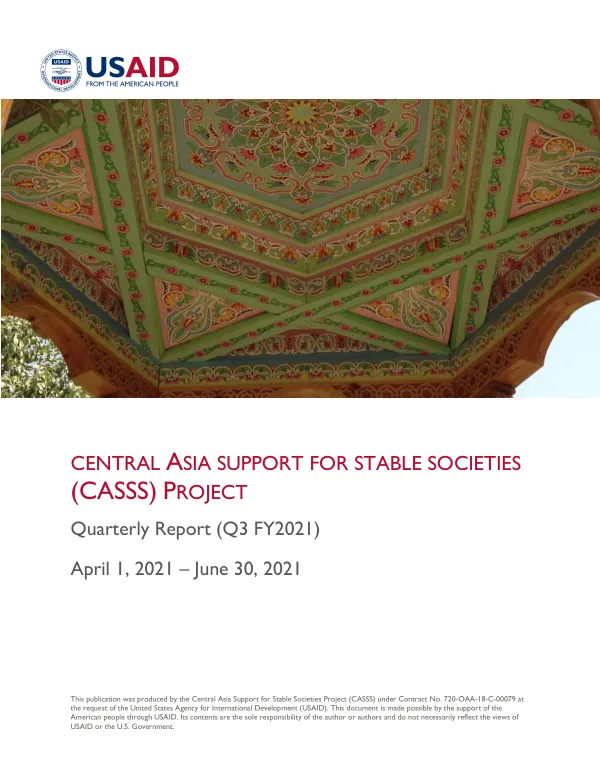
Central Asia Support for Stable Societies (CASSS) Quarterly Progress Report July 30, 2021
Sign inDAI GLOBAL, LLC
Central Asia Support for Stable Societies (CASSS) Quarterly Progress Report July 30, 2021
The Central Asia Support for Stable Societies (CASSS) Project is a USAID-funded initiative aimed at countering violent extremism (CVE) in Central Asia.
2021 · 31 pages
Sign in to readA free account is required to download.
Abstract
The project applies a public health model to research, design, pilot, and evaluate CVE programming across digital and real-world environments. The project's objectives are to identify risk and protective factors to violent extremism, design pilot interventions based on these findings, and develop a nuanced understanding of violent extremism in the regional and country context. The CASSS Project program model is comprised of four project phases, each with specific objectives and outputs. The first phase involved conducting background research to identify the extent of the violent extremism problem in Central Asia. Based on this research, the project designed a program research agenda to identify and test risk and protective factors for extremism. The Research Implementation Phase involved conducting qualitative and quantitative field and digital research to identify risk and protective factors for violent extremism. During the third quarter of FY2021, the CASSS teams and management focused on implementing seven grant approvals and three modification/extensions for existing grants that were submitted during the second quarter. The project also submitted one grant request and four modification requests throughout Q3. Ensuring the technically sound and supported start-up of eight new grant projects was a significant undertaking for the CASSS teams, setting in motion the programmatic efforts for the final year of the CASSS project. The project continued its efforts to share the final CASSS research results and programming lessons learned with USAID, other US government partners, and regional government partners. This included briefings for members of the Central Asia Regional Mission, Washington-based Asia Bureau, and Office of Transition Initiatives on the CASSS research findings and recent lessons learned/program learning report. The project also conducted final evaluations for completed activities, guided by the CASSS Monitoring, Evaluation, and Learning Plan (MEL Plan). The CASSS teams in all four countries primarily worked from home due to the ongoing risks of COVID-19, with exceptional events or meetings being conducted on-site and with significant risk mitigation precautions. The project received approvals for the submissions of the DAI Risk Assessment Tool for the Kyrgyz Republic, Tajikistan, and Uzbekistan, allowing for those offices to undergo a limited reopening. However, these offices were closed again before the end of the quarter due to the rise in COVID-19 case numbers throughout Central Asia. The project also underwent personnel changes, with Grants, Finance and Operations Director (GFOD) Gwendolyn Tweed departing and being replaced by David Chityan, who joined CASSS with over two decades of transferable and relevant experience. The project also welcomed Mamed Askerov as the new USAID Uzbekistan Activity Manager for CASSS and Dilafruz Zoirova as the new USAID Tajikistan Activity Manager for CASSS. The CASSS Project's phased implementation framework is comprised of four project phases, each with specific objectives and outputs. The project's research and programming efforts are guided by the public health model, which aims to identify risk and protective factors to violent extremism and design pilot interventions based on these findings. The project's research and programming activities are ongoing, with a focus on developing a nuanced understanding of violent extremism in the regional and country context.