USAID DEC
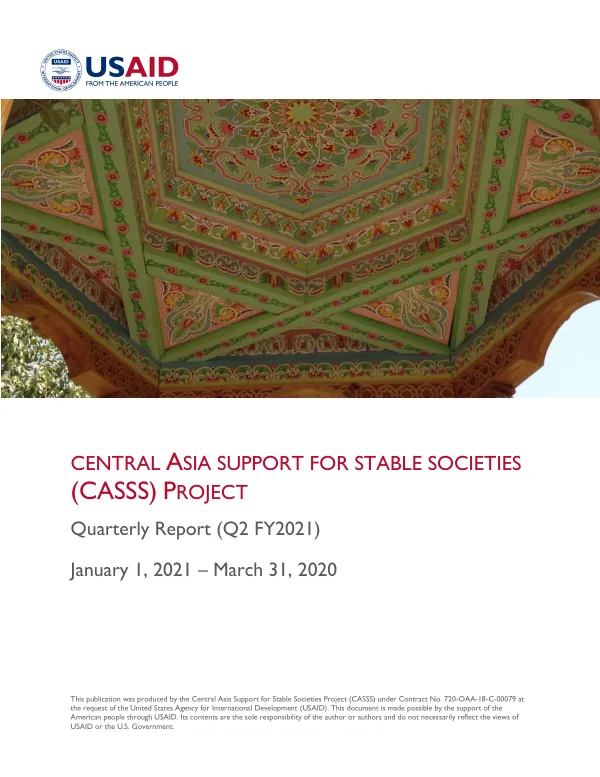
Central Asia Support for Stable Societies (CASSS) Quarterly Progress Report Q2 FY2021
Sign inDAI GLOBAL, LLC
Central Asia Support for Stable Societies (CASSS) Quarterly Progress Report Q2 FY2021
The Central Asia Support for Stable Societies (CASSS) project is a USAID-funded initiative aimed at countering violent extremism (CVE) in the Central Asian region.
2021 · 36 pages
Sign in to readA free account is required to download.
Abstract
The project began in 2018 and is scheduled to conclude in 2022. CASSS is applying a public health model to research, design, pilot, and evaluate CVE programming across digital and real-world environments. The project's objectives are to research, design, and identify risk and protective factors to violent extremism, and to design pilot interventions based on these findings. CASSS is developing a nuanced understanding of violent extremism in both the regional and country context by using a mix of digital and real-world research and pilot activities. The project team is identifying violent extremism risk and protective factors at the societal, community, and individual levels, describing trends in the pathways and processes of radicalization, and identifying country-specific communities that are most vulnerable to extremist influence. During the second quarter of year three, the CASSS project completed its Second Programming Strategy Review Session (PSRS). The PSRS involved sharing program learning to date with regional teams and USAID, updating and ranking country program priorities, and agreeing on country-specific activity workplans for the next period of performance. The PSRS also laid out priorities for CASSS in its final year, including expanding core programming approaches to conduct impact evaluations, developing pilot activities to address programming gaps, and continuing to invest in capacity building in each CASSS activity. Through a series of facilitated sessions with teams between December and January, CASSS developed country-specific Activity Workplans that entailed updated programming priorities and grant activity concepts. These Workplans were proposed roadmaps to guide each team's work over the months ahead. The CASSS Programming Framework for the final year included five program-wide programming priorities: Risk Awareness Raising, Life Skills/PVE Curriculum, Multi-layered Family Support, Mentorship, and Communications. Following the yellow light of Workplans in Kazakhstan, the Kyrgyz Republic, Tajikistan, and a concept in Uzbekistan, the technical focus of CASSS teams and Management was to develop and submit grant requests based on those workplans. With six grant requests submitted, seven grant approvals received, and three modification/extensions for existing grants submitted and approved, this was a busy quarter of activity development and sets in motion the programmatic efforts for the final year of the CASSS project. During the quarter, CASSS monitoring, evaluation, and learning (MEL) efforts focused on designing and implementing monitoring and evaluation plans for CASSS pilot activities, including ongoing monitoring of all activities in implementation, context monitoring, conducting final evaluations for completed activities, and producing the CASSS Pilot Programming Lessons Learned 2 report. Key accomplishments of this period include the completion of six final evaluation reports, design of monitoring and evaluation plans for six new activities, and completion of the Pilot Programming Lessons Learned Report 2. CASSS continued to conduct most staff and programming activities remotely due to the ongoing risks of COVID-19. Teams in all four CASSS countries primarily worked from home, with exceptional events or meetings being conducted on-site and with significant risk mitigation precautions. CASSS initiated submissions of the DAI Risk Assessment Tool to be poised and prepared for partial and phased reopening of country offices pending the COVID case number trends per country. In March 2021, CASSS said farewell to several USAID/Central Asia Regional Mission staff members, including the Acting Director of Governance and Democracy and CASSS COR Karolyn Kuo, USAID Kyrgyz Republic Senior Specialist for Democratic Development and CASSS ACOR/Activity Manager Adrienne Stone, and USAID Tajikistan Governance Specialist and CASSS Activity Manager Munisa Abrori. The CASSS team welcomed new staff members, including Christian Fung as the Regional Director, General Development Office for Democracy & Health, Madina Kusmoldanova as the new CASSS COR, and Noel Bauer as the new USAID Kyrgyz Republic Activity Manager for CASSS. The CASSS Project is applying a public health model to research, design, pilot, and evaluate CVE programming across digital and real-world environments. The project's objectives are to research, design, and identify risk and protective factors to violent extremism, and to design pilot interventions based on these findings. CASSS is developing a nuanced understanding of violent extremism in both the regional and country context by using a mix of digital and real-world research and pilot activities. The project team is identifying violent extremism risk and protective factors at the societal, community, and individual levels, describing trends in the pathways and processes of radicalization, and identifying country-specific communities that are most vulnerable to extremist influence. The CASSS Project program model is comprised of four project phases, each with specific objectives and outputs that are used to define an activity's workplan and budget. The four project phases are: Phase 1 - Research and Design, Phase 2 - Pilot Implementation, Phase 3 - Evaluation and Impact Assessment, and Phase 4 - Scaling Up