USAID DEC
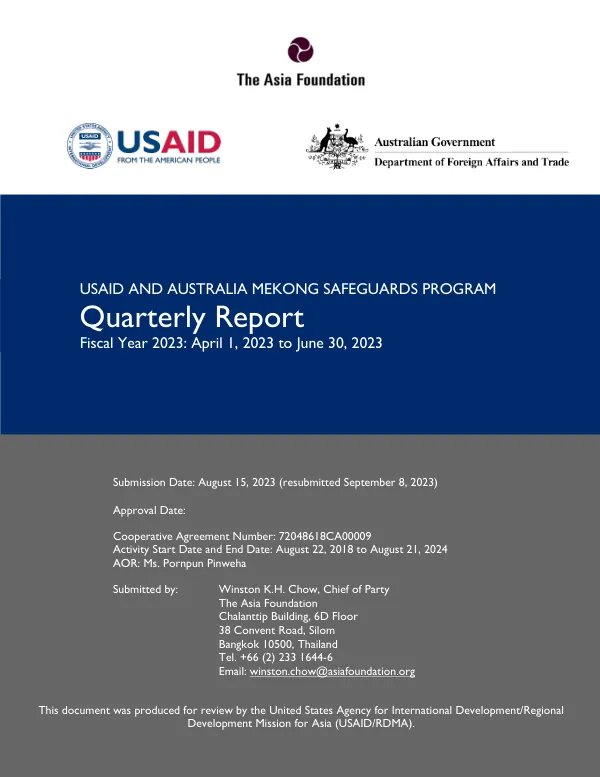
USAID and Australia Mekong Safeguards Program Quarterly Report – Fiscal Year 2023: April 1, 2023 – June 30, 2023
Sign inTHE ASIA FOUNDATION
USAID and Australia Mekong Safeguards Program Quarterly Report – Fiscal Year 2023: April 1, 2023 – June 30, 2023
The USAID and Australia Mekong Safeguards Program is a six-year initiative that aims to promote sustainable infrastructure development in the Mekong subregion.
2023 · 45 pages
Sign in to readA free account is required to download.
Abstract
The program supports policymakers, government regulators, and other stakeholders with technical assistance, knowledge, and tools to foster consistent application of strengthened environmental and social (E&S) governance standards. The program focuses on the energy, transport, and water sectors, and its vision is to operationalize the sustainable infrastructure development that Mekong subregion countries have put forward in their national green-growth strategies and regional platforms. The program's goal is to promote profitable economic growth supported by sustainable infrastructure that causes less harm to the environment, biodiversity, and people. To achieve this, the program promotes sustainable infrastructure development, improves the application of ESG standards, policies, and practices, and promotes integrated approaches to develop sustainable infrastructure plans. The program's target countries are Cambodia, Lao PDR, Myanmar, Thailand, and Vietnam. The program's partnership with the Australian Department of Foreign Affairs and Trade (DFAT) was formalized on June 9, 2021. The partnership aims to support the development of sustainable infrastructure in the Mekong subregion, particularly in the energy, transport, and water sectors. The program's partnership with USAID was established in 2018 and is expected to continue until August 2024. The program's geographic coverage includes the Mekong subregion countries of Cambodia, Lao PDR, Myanmar, Thailand, and Vietnam. The program's reporting period is from April 1, 2023, to June 30, 2023. The program's reporting is submitted to the USAID Regional Development Mission for Asia (USAID/RDMA) and is intended to provide an update on the program's progress and achievements during the reporting period. The program's implementation is led by The Asia Foundation (TAF), which is the prime implementing partner. The program's sub-awardees include The Henry L. Stimson Center, Global Environmental Institute (GEI), China International Contractors Association (CHINCA), and Beijing Rongzhi Corporate Social Responsibility Institute (Rongzhi). The program's budget is supported by USAID and DFAT, with a total budget of $X million. The program's activities are focused on promoting sustainable infrastructure development, improving the application of ESG standards, and promoting integrated approaches to develop sustainable infrastructure plans. The program's activities include technical assistance, knowledge sharing, and capacity building for policymakers, government regulators, and other stakeholders. The program's activities also include the development of sustainable infrastructure plans, the promotion of ESG standards, and the provision of training and capacity building for stakeholders. The program's progress and achievements during the reporting period are presented in the following sections. The program's progress is evaluated against its key performance indicators (KPIs), which include the number of stakeholders trained, the number of sustainable infrastructure plans developed, and the number of ESG standards promoted. The program's challenges and lessons learned during the reporting period are also presented. The program's challenges include the need for more effective coordination among stakeholders, the need for more effective communication of the program's results, and the need for more effective monitoring and evaluation of the program's progress. The program's recommendations for the next quarter are also presented. The program's recommendations include the need to continue to promote sustainable infrastructure development, the need to improve the application of ESG standards, and the need to promote integrated approaches to develop sustainable infrastructure plans. The program's monitoring, evaluation, and learning (MEL) plan is also presented. The MEL plan outlines the program's approach to monitoring and evaluating its progress, including the use of KPIs, the use of surveys and focus group discussions, and the use of case studies and lessons learned. The program's performance management plan is also presented. The performance management plan outlines the program's approach to managing its performance, including the use of KPIs, the use of performance indicators, and the use of a results-based management approach. The program's indicator reporting is also presented. The indicator reporting outlines the program's approach to reporting its progress against its KPIs, including the use of a dashboard, the use of a reporting template, and the use of a data management system. The program's cross-cutting activities are also presented. The cross-cutting activities include the promotion of gender equality and women's empowerment, the promotion of climate change and environment, and the promotion of economic opportunity. The program's contributions to USAID RDCS regional environment office relevant key issues are also presented. The program's contributions include the promotion of economic opportunity, the promotion of climate change and environment, and the promotion of gender equality and women's empowerment. The program's activities and events in the next quarter are also presented. The program's activities and events include the promotion of sustainable infrastructure development, the promotion of ESG standards, and the promotion of integrated approaches to develop sustainable infrastructure plans. The program's monitoring, evaluation, and learning (MEL) plan is also presented. The MEL plan
Related documents