USAID DEC
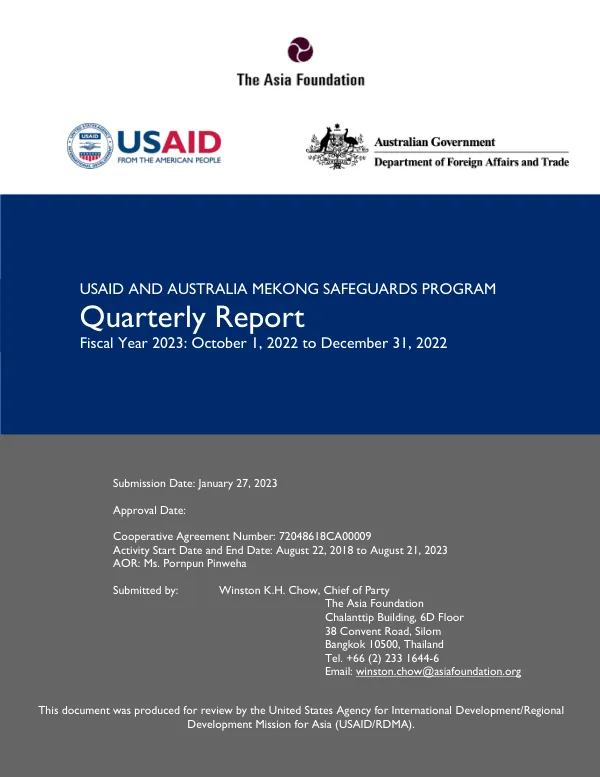
USAID and Australia Mekong Safeguards Program Quarterly Report – Fiscal Year 2023: October 1, 2022-December 31, 2022
Sign inTHE ASIA FOUNDATION
USAID and Australia Mekong Safeguards Program Quarterly Report – Fiscal Year 2023: October 1, 2022-December 31, 2022
The USAID and Australia Mekong Safeguards Program is a six-year initiative that aims to promote the consistent application of strengthened environmental and social governance standards in the Mekong subregion.
2023 · 43 pages
Sign in to readA free account is required to download.
Abstract
The program supports policymakers, government regulators, major financiers, developers, contractors, and communities with technical assistance, knowledge, and tools to foster sustainable infrastructure development. The program's vision is aligned with the national green-growth strategies and regional platforms of Mekong subregion countries, which have been championed by major infrastructure financiers such as the World Bank, the Asian Development Bank, and several bilateral donors. The program's geographic coverage includes the Mekong subregion countries of Cambodia, Lao PDR, Myanmar, Thailand, and Vietnam, as well as China. The program's reporting period for this quarterly report is from October 1, 2022, to December 31, 2022. The program's prime implementing partner is The Asia Foundation, and the agreement number is USAID Agreement # 72048618CA00009. The program's objectives are to operationalize the vision of sustainable infrastructure development in the Mekong subregion, particularly in the energy, transport, and water sectors. The program aims to provide technical assistance, knowledge, and tools to policymakers, government regulators, major financiers, developers, contractors, and communities to foster consistent application of strengthened environmental and social governance standards. The program's activities are divided into five components: Activity A, Promoting Regional Dialogue and Knowledge Exchange; Activity B, Enhancing Sustainable Infrastructure Development and Planning; Activity C, Accelerating ESG Policies in the Mekong Subregion; Activity D, Strengthening ESG Standards and Practices for Private Sector; and Activity E, Cross-Cutting Activities. The program's implementation progress is reported in the following sections. Activity A, Promoting Regional Dialogue and Knowledge Exchange, aimed to facilitate regional dialogue and knowledge exchange among policymakers, government regulators, major financiers, developers, contractors, and communities. The activity involved organizing workshops, seminars, and training programs to promote the sharing of best practices and experiences in sustainable infrastructure development. Activity B, Enhancing Sustainable Infrastructure Development and Planning, focused on enhancing the capacity of policymakers, government regulators, and developers to plan and implement sustainable infrastructure projects. The activity involved providing technical assistance, training, and capacity-building programs to enhance the skills and knowledge of stakeholders in sustainable infrastructure development. Activity C, Accelerating ESG Policies in the Mekong Subregion, aimed to accelerate the development and implementation of environmental and social governance policies in the Mekong subregion. The activity involved providing technical assistance, training, and capacity-building programs to policymakers, government regulators, and developers to enhance their understanding and application of ESG policies. Activity D, Strengthening ESG Standards and Practices for Private Sector, focused on strengthening the environmental and social governance standards and practices of private sector companies operating in the Mekong subregion. The activity involved providing technical assistance, training, and capacity-building programs to private sector companies to enhance their understanding and application of ESG standards and practices. Activity E, Cross-Cutting Activities, involved providing technical assistance, training, and capacity-building programs to stakeholders in the Mekong subregion to enhance their understanding and application of sustainable infrastructure development principles and practices. The program's implementation progress is reported in the following sections. The program's performance management plan update is provided in Section 7.1, and the indicator reporting is provided in Section 7.2. The program's contributions to USAID RDCS REO relevant key issues are reported in Section 5. The program's activities and events in the next quarter are reported in Section 6. The program's performance management plan update is provided in Section 7.1, and the indicator reporting is provided in Section 7.2. The program's contributions to USAID RDCS REO relevant key issues are