USAID DEC
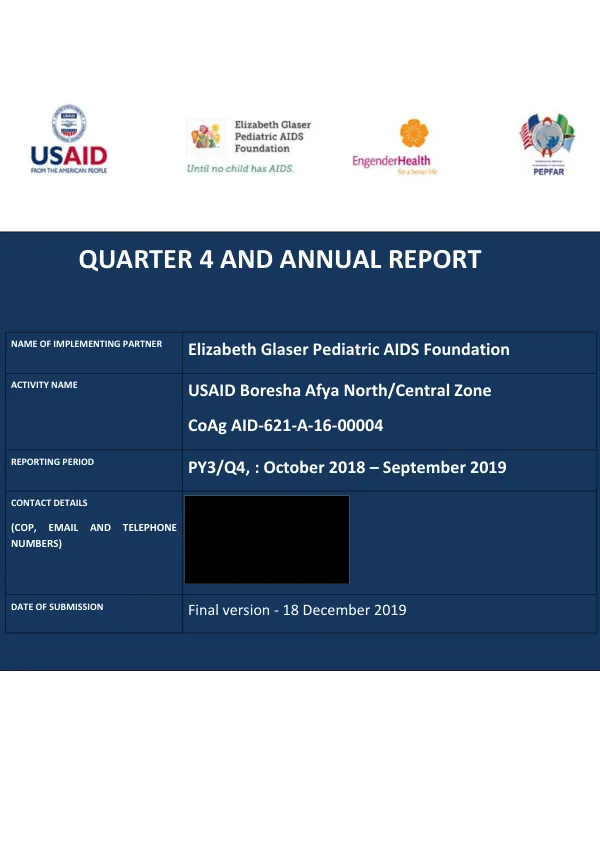
USAID Boresha Afya – CoAg AID-621-A-16-00004 – PY3 Quarter 4 and Annual Report: October 2018 - September 2019
Sign inELIZABETH GLASER PEDIATRIC AIDS FOUNDATION
USAID Boresha Afya – CoAg AID-621-A-16-00004 – PY3 Quarter 4 and Annual Report: October 2018 - September 2019
The USAID Boresha Afya activity in Tanzania aims to improve the health status of all Tanzanians by increasing access to quality, integrated services, particularly in reproductive, maternal, neonatal, child, and adolescent health.
2019 · 132 pages
Sign in to readA free account is required to download.
Abstract
The activity is implemented by the Elizabeth Glaser Pediatric AIDS Foundation and is funded by the United States Agency for International Development (USAID) under the Cooperative Agreement AID-621-A-16-00004. The activity began on October 1, 2016, and will conclude on December 31, 2021. The activity focuses on three result areas: Improved Enabling Environment for Health Service Provision, Improved Availability of Quality, Integrated Health Services at the Facility Level, and Increased Access to Health Services at the Community Level. In the first result area, the activity aims to develop and improve policies, guidelines, and protocols to enable the provision of integrated, quality health services at facilities with links to communities. Technical assistance is provided to the Government of Tanzania to develop, communicate, and execute national plans. In the second result area, the activity focuses on increasing the provision of quality, integrated services at facilities, supporting districts and regions for increased accountability and responsiveness in service delivery, and strengthening client-provider interactions to promote respectful, informed care. The activity also aims to increase the availability of quality, integrated health services at the facility level, with a focus on reproductive, maternal, neonatal, child, and adolescent health. The activity has made significant progress in the third result area, with a focus on strengthening connections between households and health facilities through preventative, curative, and health promotion activities by community health workers. The activity has also supported community and mobile outreach to increase service coverage, with a focus on reaching marginalized and hard-to-reach populations. The activity has achieved several key results, including a 27% increase in household income among program participants compared to the control group, and improved food security indicators across all target communities. The activity has also strengthened client-provider interactions, with a focus on promoting respectful, informed care. The activity has also supported the development of policies, guidelines, and protocols to enable the provision of integrated, quality health services at facilities with links to communities. The activity has also implemented several cross-cutting activities, including gender mainstreaming, monitoring, evaluation, and learning. The activity has also identified several best practices and success stories, including the use of community health workers to strengthen connections between households and health facilities. The activity has also identified several lessons learned and recommendations for the next project year, including the need to continue strengthening client-provider interactions and increasing the availability of quality, integrated health services at the facility level. The activity has also made significant progress in implementing its work plan, with a focus on achieving the project's objectives and outcomes. The activity has also conducted several trainings and capacity-building activities for health care workers, with a focus on improving their skills and knowledge in providing quality, integrated health services. Overall, the USAID Boresha Afya activity in Tanzania has made significant progress in improving the health status of all Tanzanians, particularly in reproductive, maternal, neonatal, child, and adolescent health. The activity has achieved several key results, including a 27% increase in household income among program participants compared to the control group, and improved food security indicators across all target communities. The activity has also strengthened client-provider interactions, with a focus on promoting respectful, informed care.