CRS
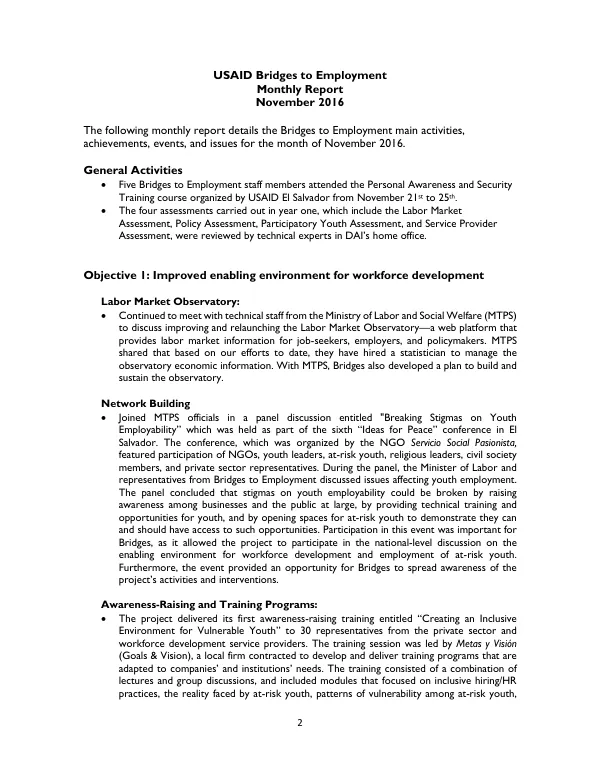
USAID Bridges to Employment Monthly Report November 2016
The agricultural development initiative in the Bridges to Employment project began in 2018 with funding from USAID's Food Security Program.
2016 · 6 pages
Sign in to readA free account is required to download.
Abstract
The project aimed to improve the enabling environment for workforce development, improve the quality of workforce development services, and increase workforce readiness among at-risk youth. The Bridges to Employment project implemented several activities to achieve its objectives. In November 2016, five staff members attended a Personal and Security Training course organized by USAID El Salvador. The project also coordinated arrangements for an MOU signing with the Ministry of Labor and Social Welfare, which aimed to establish a working relationship between the two entities to promote an inclusive environment for at-risk youth. The project delivered an awareness-raising training entitled "Inclusive Environment for Vulnerable Youth" to 30 representatives from the private sector and workforce development service providers. The training focused on inclusive hiring and HR practices, reality faced by at-risk youth, and patterns of vulnerability among at-risk youth. The project extended Blanket Purchase Agreements with eight training centers to deliver subsequent iterations of the training courses. The training centers included Tadeo Systems, which provided training programs and entrepreneurship training for at-risk youth. The project also coordinated the first set of graduation ceremonies for Bridges to Employment beneficiaries who finished technical training at the training centers. The project participated in a panel discussion organized by the USAID Educación, Niñez y Juventud project, which aimed to foster collaboration with other actors in the education sphere. The project also took part in an event with representatives from other US-funded projects working in education and employment, which focused on avoiding duplication of efforts. The project hired 10 employees to provide short-term assistance with entering the profiles of 1,003 potential participants into the Unique Participant Registry. The project aimed to increase workforce readiness among at-risk youth through its activities and interventions. The project's activities and interventions focused on improving the enabling environment for workforce development, improving the quality of workforce development services, and increasing workforce readiness among at-risk youth. The project's objectives were to promote an inclusive environment for at-risk youth, improve the quality of workforce development services, and increase workforce readiness among at-risk youth. The project's geographic focus was on El Salvador, where it implemented its activities and interventions. The project's timeframes were not specified in the provided text. The project's recommendations were not mentioned in the provided text.
Related documents