USAID DEC
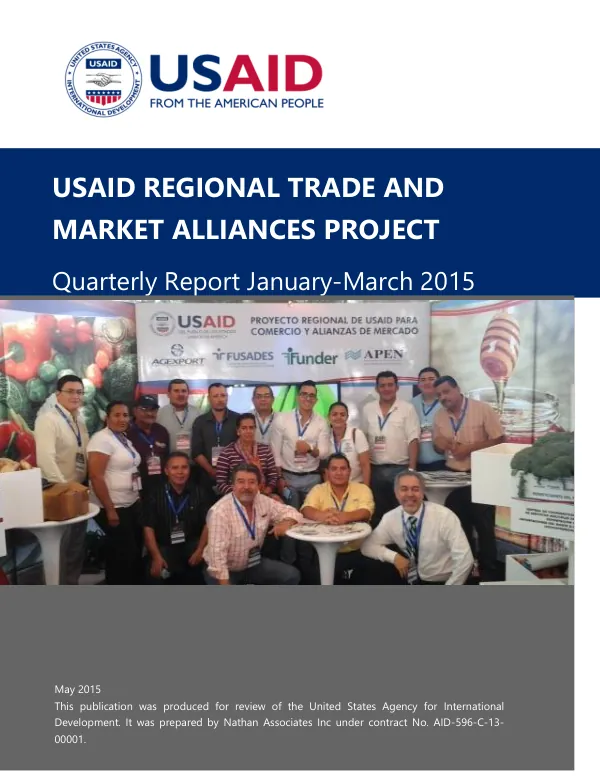
USAID Regional Trade and Market Alliances Project January – March 2015 Quarterly Report
Sign inAGEXPORT
USAID Regional Trade and Market Alliances Project January – March 2015 Quarterly Report
Regional Trade and Market Alliances Project implementation has been underway for two years, with significant advances made in the second year.
2015 · 71 pages
Sign in to readA free account is required to download.
Abstract
Project activities have exceeded contractual goals in many cases, producing results far beyond expectations. The project is now positioned to sustain and increase efforts in the coming year. Collaboration with stakeholders has been a key aspect of project implementation. A robust network of partners has been established, including local producer organizations, research and technical institutions, chambers of commerce and export associations, and regional integration organizations. These stakeholders have been involved in program design and are participating in activity implementation at the local, national, and regional levels. The project has strengthened ties with the Central American Economic Integration Council (SIECA), providing technical assistance to support urgent actions on trade facilitation in the region. The formalization of the WTO Agreement on Trade Facilitation and political will from Central American governments have brought life to implementing on-the-ground operational changes. Collaboration has also been close with grant recipient local technical partners, who are proving themselves as effective national anchor organizations for implementing grant activities in the next year. These partners are also able to continue supporting small and medium enterprises (SMEs) when the project is complete. The project's team has undergone realignment, with new staff added and the structure reorganized to best fulfill project needs and take advantage of personnel talent and skills. This realignment has enabled the project to better address the needs of stakeholders and implement activities more effectively. Component One of the project has focused on trade facilitation, with a particular emphasis on reducing trade barriers and improving the business environment. The project has worked with local producer organizations and research institutions to identify areas where trade facilitation can be improved, and has provided technical assistance to support the implementation of these improvements. Component Two has focused on market alliances, with a particular emphasis on promoting the development of regional value chains. The project has worked with local producer organizations, research institutions, and export associations to identify opportunities for value chain development, and has provided technical assistance to support the implementation of these opportunities. The Grants Program has provided funding to local technical partners to support the implementation of grant activities. These activities have focused on promoting the development of SMEs and improving the business environment in the region. Cross-Cutting Activities have included monitoring and evaluation, communications, training, administration and finance management, human resources, accounting and finance, and budgeting. These activities have been critical to the success of the project, enabling the project team to track progress, communicate with stakeholders, and manage the project's finances and resources effectively. The project has made significant progress in the second year, with many activities exceeding contractual goals and producing results far beyond expectations. The project is now positioned to sustain and increase efforts in the coming year, with a robust network of partners and a strong team in place to support implementation.
Related documents