USAID DEC
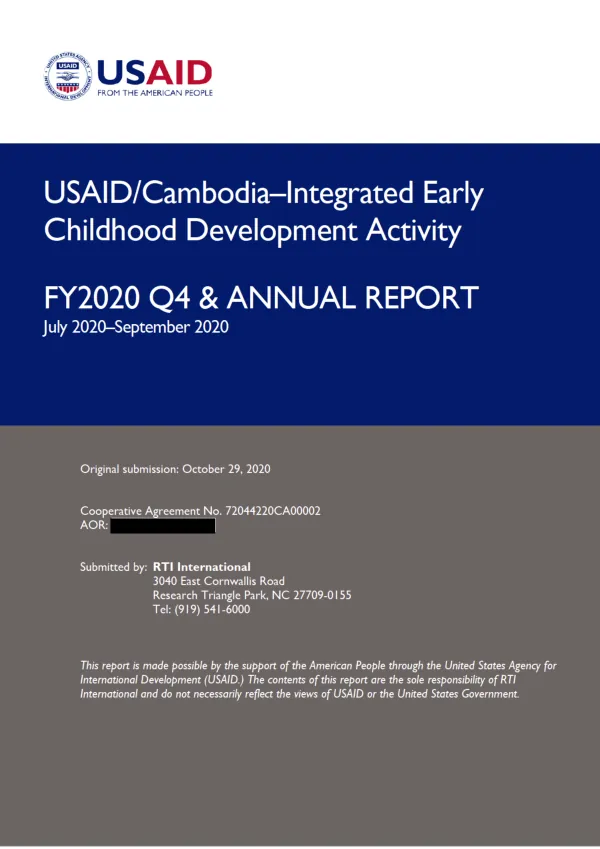
USAID/Cambodia-Integrated Early Childhood Development Activity FY2020 Q4 & Annual Report July 2020-September 2020
Sign inHELLEN KELLER INTERNATIONAL
USAID/Cambodia-Integrated Early Childhood Development Activity FY2020 Q4 & Annual Report July 2020-September 2020
The Cambodia Integrated Early Childhood Development (IECD) Activity began on July 17, 2020, with the goal of supporting children in Cambodia to not just survive, but to thrive and reach their full developmental potential.
2020 · 11 pages
Sign in to readA free account is required to download.
Abstract
The project takes an integrated approach and aligns with the Royal Government of Cambodia (RGC) and USAID strategies and frameworks across multiple sectors. The project works to strengthen nutrition service delivery in health facilities and in communities; supports nutrition-sensitive agriculture and improved livelihoods; improves water, sanitation, and hygiene (WASH) practices among caregivers; facilitates screening and access to services for children who may have developmental delays and disabilities; and promotes responsive caregiving to help children meet critical developmental milestones. The focus of IECD is on the early childhood years, with emphasis on the first 1,000 days (conception to age 2). IECD's three main objectives are: Objective 1, Improved physical, cognitive, linguistic, socio-emotional development of young children; Objective 2, Decreased stunting rates for children under 5 among the target population; and Objective 3, Children with developmental delays and disabilities receive appropriate care in target provinces. Through Objective 1 activities, IECD will create optimal conditions for all children's development by building the skills of families, health providers, and community leaders to provide and promote nurturing care. Through Objective 2, IECD will address children's physical development by improving families' abilities to produce or procure nutritious foods; by helping families generate income to support livelihoods; by promoting consumption of nutritious diets; and by strengthening the integration of WASH, health services, and early childhood development (ECD) services. The IECD Theory of Change posits that if the enabling environment, service providers, and families are all supported to promote holistic, integrated nurturing care for children with and without developmental delays and disabilities, then an increased percentage of Cambodian children will thrive and meet developmental milestones. The project works to ensure children thrive and meet their full developmental potential through provision of technical assistance to support three objectives. In the next report, additional information on each activity will be included. The project has identified several key results, including increased capacity of caregivers to provide nurturing care for children with and without developmental delays and disabilities, increased capacity and improved attitudes, behaviors, and practices of service providers to educate and support caregivers with young children about nurturing care, and strengthened enabling environment at the national and sub-national levels to promote the institutionalization of ECD activities. Implementation progress for the IECD Activity during the period of July to September 2020 focused on project start-up, activities and progress, plans for the next quarter, partnerships and collaboration, and opportunities, challenges, and solutions. The project has established partnerships with several implementing partners, including Helen Keller International, and has begun to implement activities in support of the three objectives. The project has also identified several opportunities, challenges, and solutions, including the need to strengthen the enabling environment at the national and sub-national levels to promote the institutionalization of ECD activities. Key personnel and recruitment for the IECD Activity include the Chief of Party, Deputy Chief of Party, and other project staff. The project has also established a recruitment plan to ensure that the project has the necessary personnel to implement the activities. The project management team is responsible for overseeing the implementation of the project and ensuring that the project is meeting its objectives. The project management team includes the Chief of Party, Deputy Chief of Party, and other project staff. The project management team is responsible for overseeing the implementation of the project and ensuring that the project is meeting its objectives. The IECD Activity has made significant progress in its first quarter, with the establishment of partnerships with several implementing partners and the beginning of activities in support of the three objectives. The project has also identified several opportunities, challenges, and solutions, including the need to strengthen the enabling environment at the national and sub-national levels to promote the institutionalization of ECD activities. The project management team is responsible for overseeing the implementation of the project and ensuring that the project is meeting its objectives.
Related documents