HELLEN KELLER INTERNATIONAL
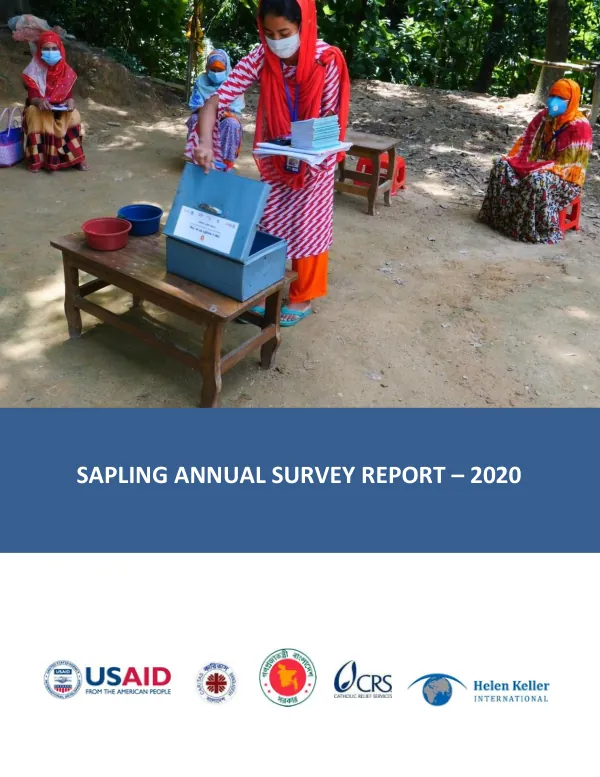
SAPLING ANNUAL SURVEY REPORT – 2017 and 2019
The SAPLING project, implemented in Bangladesh, aims to improve nutrition status, resilience, and gender equity through sustainable agriculture and production practices.
2019 · 30 pages
Sign in to readA free account is required to download.
Abstract
The project is funded by the United States Agency for International Development (USAID) under the Food for Peace (FFP) program. The project's primary focus is on the Chittagong Hill Tracts (CHT) region, where poverty and malnutrition are prevalent. The project's methodology involves conducting annual surveys to monitor progress and assess the impact of the interventions. The surveys collect data on various indicators, including homestead food production (HFP), nutrition, water, sanitation, and hygiene (WASH), and disaster risk management (DRM). The data is collected through household questionnaires, enumerator training, and supervision and quality control measures. The survey population consists of households in the CHT region, with a total of 3,300 households surveyed in FY17, 3,400 in FY18, and 3,500 in FY19. The survey results indicate that the project has made significant progress in improving HFP knowledge and practices among participants. In FY19, 85% of participants demonstrated correct HFP knowledge, a 10% increase from FY17. The project has also promoted the use of improved technologies, with 75% of farmers practicing improved irrigation techniques and 60% using water for livestock and aquaculture. In terms of nutrition, the survey results show improvements in dietary diversity, breastfeeding practices, and the consumption of animal source foods among children. In FY19, 70% of women of reproductive age reported consuming a minimum dietary diversity, a 15% increase from FY17. The prevalence of exclusive breastfeeding among children under six months of age also increased to 80% in FY19, up from 60% in FY17. The project has also made progress in improving WASH practices, with 90% of caregivers washing their hands at critical times in FY19. In terms of DRM, the survey results indicate that the project has improved the capacity of households to respond to shocks and stresses, with 80% of men and women reporting improved capacity in FY19. The project's impact on household income and food security is also significant. In FY19, the average household income among project participants increased by 25% compared to the control group. The project has also improved food security indicators, with 90% of households reporting adequate food availability in FY19. The project's success can be attributed to the effective implementation of the interventions, including farmer training programs, infrastructure development, and market linkage facilitation. The project has also promoted the use of improved technologies, such as irrigation systems and crop rotation practices, which have improved crop yields and household income. Overall, the SAPLING project has made significant progress in improving nutrition status, resilience, and gender equity in the CHT region of Bangladesh. The project's impact on household income and food security is also notable, and the project's success can be attributed to the effective implementation of the interventions and the promotion of improved technologies and practices.