SOCIAL SOLUTIONS INTERNATIONAL, INC.
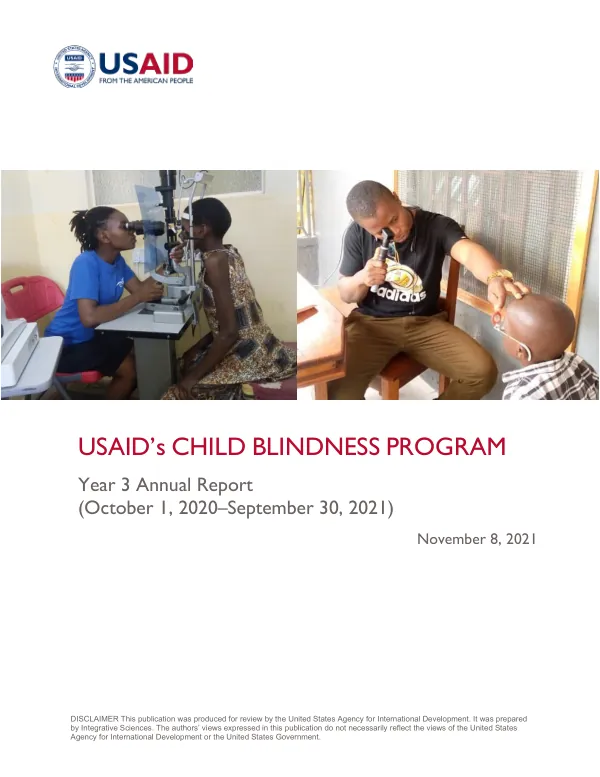
USAID Child Blindness Program Year 3 Annual Report
The Child Blindness Program (CBP) is a global initiative managed by the United States Agency for International Development (USAID) under contract 7200AA18C00058.
2021 · 44 pages
Sign in to readA free account is required to download.
Abstract
The program is implemented by prime contractor Integrative Sciences (IntSci) and two subcontractors, International Eye Foundation (IEF) and Social Solutions International (SSI). The contract period of performance is from August 23, 2018 to August 22, 2023. CBP utilizes a competitive global grants program to provide funding to organizations delivering eye care to children and other vulnerable populations with limited access to sight-saving services. The program consists of two interrelated components and corresponding objectives. Component 1 aims to increase the number of children provided with quality sight-saving eye health services, while Component 2 seeks to advance the global knowledge base on best practices and innovative approaches for pediatric eye health programs. In Year 3, CBP marked the greatest expansion of its programming in its 30-year history. Between October 2020 and September 2021, the program sought to select, negotiate, and award 36 grants competitively, totaling more than $8 million in obligated funding in 20 countries around the world. This surge in new programming was made possible by the direct support of USAID, including the approval of the Year 3 Annual Work Plan in November 2020. Additional investments in grant management tools and expansions in staffing were made during Year 3. Six new positions were added, including a Grants Assistant, Operations Assistant, Budget Analyst, Capacity Building Specialist, IEF Program Manager, and fourth Technical Advisor. These investments enabled CBP to accelerate activities and strengthen its capacity to achieve its stated goals and objectives, even in the face of the global pandemic. CBP's competitive global grants program is designed to deliver a USAID grants program that uses the full grants cycle, including the release of a Request for Applications (RFA), review and selection of projects for funding, monitoring, evaluation, and learning (MEL) around program activities, and targeted organizational capacity building. The program's objectives are to expand the availability and accessibility of quality eye health services for children and other vulnerable groups, enhance the administrative, technical, and financial capacity of grant recipients, and strengthen the monitoring, evaluation, and learning approach and review process of grant-funded activities. The program's second component aims to advance the global knowledge base on best practices and innovative approaches for pediatric eye health programs. This is achieved through the expansion of evidence-based and innovative approaches in testing, design, and scale-up for eye health in various country contexts, as well as the broadening of communication and networking platforms to share program experiences and grantee resources. Between October 2020 and September 2021, CBP continued to implement and close out grants awarded prior to Year 3, as well as launch the fourth and final RFA to initiate Grant Round 4 (GR4) in August 2021. The program's activities were further supported by the addition of new staff members, including a Grants Assistant, Operations Assistant, Budget Analyst, Capacity Building Specialist, IEF Program Manager, and fourth Technical Advisor. The Child Blindness Program's Year 3 Annual Report highlights the program's achievements and challenges during the period from October 2020 to September 2021. The report provides an overview of the program's activities, including the selection, negotiation, and award of grants, as well as the implementation and close-out of previous grants. The report also highlights the program's investments in grant management tools and staffing, as well as its efforts to advance the global knowledge base on best practices and innovative approaches for pediatric eye health programs.