CHEMONICS
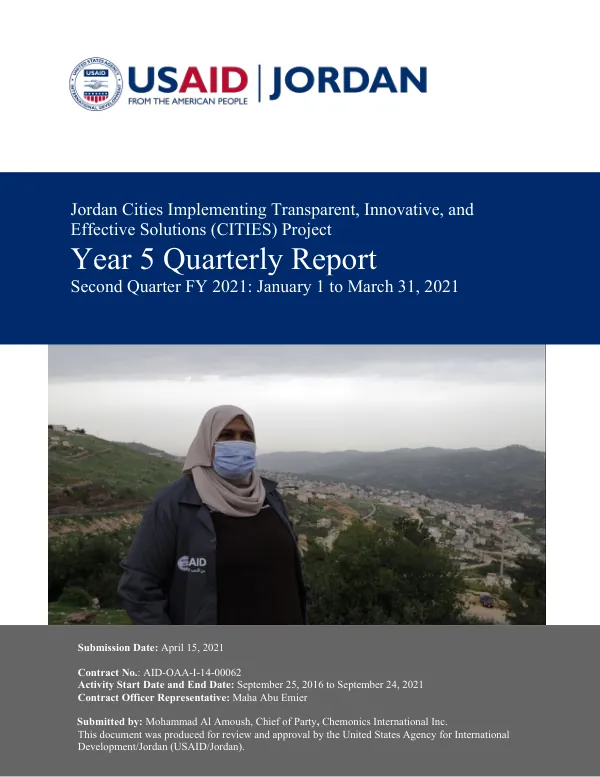
USAID CITIES, First Quarterly Report FY 2021/YEAR 5 (October 1 – December 31, 2020)
The USAID CITIES Project is a five-year program launched in September 2016 to increase the effectiveness of municipal governance and support local administration in Jordan.
2021 · 83 pages
Sign in to readA free account is required to download.
Abstract
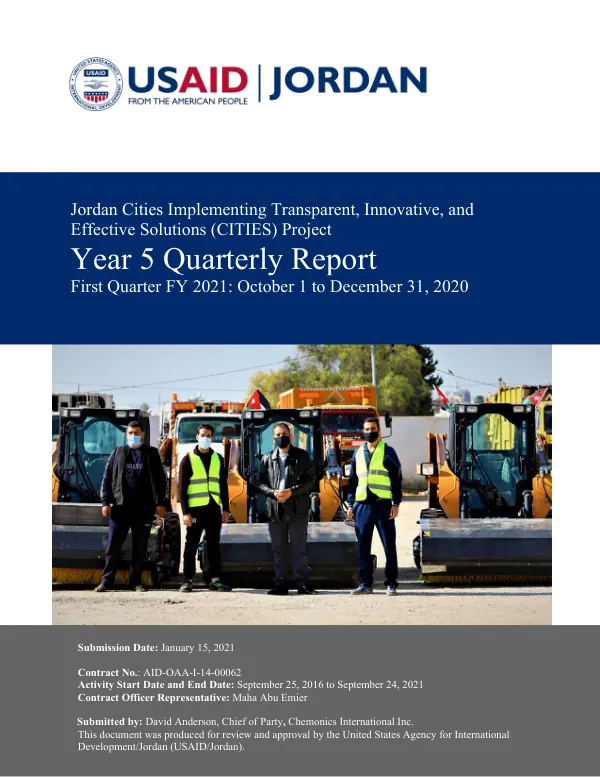
The project is organized around three themes: Improved Service Delivery; Improved Internal Management; and Community Engagement and Cohesion. In addition, the project has two crosscutting technical themes – Municipal Investments and Recovery; and Gender Equity and Social Inclusion (GESI) – in addition to other crosscutting efforts in support of training and capacity building, grants, monitoring, evaluation and learning (MEL), and communications and outreach. The project focuses on 33 primary partner municipalities of various sizes across 12 governorates. However, for some activities, the project supports more municipalities, including mapping street names and building numbers in 100 municipalities and drafting local development plans in 73 municipalities. The project closely coordinates its activities with a broad range of Jordanian stakeholders and beneficiaries at the central, governorate, municipal, and community levels, as well as with USAID, implementing partners, and other donors supporting municipal governance, local administration, and economic development in Jordan. The project's key stakeholders are the Ministry of Local Administration (MOLA), Ministry of Interior (MOI), Ministry of Planning and International Cooperation (MOPIC), Ministry of Political and Parliamentary Affairs (MOPPA), Governorate Local Development Directorates (GLDDs), Municipal Local Development Units (MLDUs), municipalities, local councils, and communities. The project follows a horizontal, one-team approach to foster collaboration, knowledge sharing, and learning across all project themes and crosscutting activities. The project's objectives are to implement innovative and sustainable solutions to improve service delivery, increase the sustainability of current municipal operations and local administration, enhance engagement between community members and the government, foster community cohesion, and promote local economic development. To achieve these objectives, the project is implementing various activities, including training and capacity building, grants, monitoring, evaluation and learning (MEL), and communications and outreach. The project has made significant progress in the first quarter of Year 5, with key achievements including the delivery of new skid steers to municipalities, which has helped to address a shortage in municipal workers and improve waste collection operations. The project has also conducted a data quality assessment (DQA) to ensure the accuracy and reliability of data collected. Additionally, the project has supported the development of a financial management information system (FMIS) to improve financial management and reporting. The project has also made progress in improving internal management, including the development of a management and administration plan, which outlines the project's organizational structure, roles, and responsibilities. The project has also established a monitoring, evaluation, and learning (MEL) system to track progress and identify areas for improvement. In terms of community engagement and cohesion, the project has supported the development of a community engagement strategy, which outlines the project's approach to engaging with community members and promoting community cohesion. The project has also conducted community outreach activities, including the distribution of information materials and the organization of community events. The project has also made progress in promoting local economic development, including the support of small and medium-sized enterprises (SMEs) and the development of a local economic development plan. The project has also established partnerships with local businesses and organizations to promote economic development and job creation. Overall, the USAID CITIES Project has made significant progress in the first quarter of Year 5, with key achievements in improved service delivery, internal management, community engagement and cohesion, and local economic development. The project continues to work closely with its stakeholders to achieve its objectives and promote sustainable results and impact.