DAI
USAID/Compete Monthly Report February 1 – February 29, 2016
The USAID/Compete Project is a program aimed at strengthening the competitiveness of the Palestinian private sector in key sectors essential to the future prosperity of the Gazan economy.
2016 · 42 pages
Sign in to readA free account is required to download.
Abstract
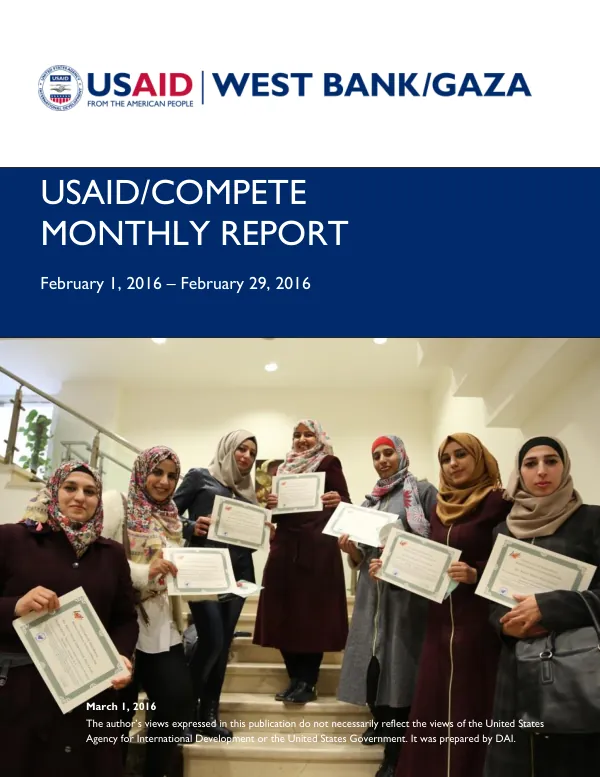
The project supports the agribusiness, fishing, ICT, furniture, textile and garment, and domestic tourism sectors. In the West Bank, the program focuses on building the production capacity of firms to grow locally and expand regionally and internationally, addressing key market failures that will open the horizon for new value chains. In the West Bank, the Agronomist Capacity Building Program celebrated the graduation of 28 Palestinians who received necessary skills in agricultural practices to meet industry needs and find employment within the sector. As a result, 18 trained agronomists have found employment and signed contracts with agribusiness companies. This program aimed to solve one of the most critical impediments faced by key agricultural sub-sectors, which is finding qualified agronomists to manage the quality and productivity of local farms. In the ICT sector, the SAP Young Professional Program graduated its first group of students, who earned valuable high-tech skills to support the Middle East's Digital Economy. The program, co-funded by USAID, provided 18 Palestinians with SAP software knowledge certification and soft skill development workshops. The aim of this program is to support the creation of sustainable workplaces by boosting the business system knowledge of young graduates in the region. In Gaza, the design for the scalability high-value production patterns program has been underway in the vegetable and fresh herbs subsectors. This initiative is expected to open up new opportunities for a great number of farmers in Gaza, with 70 beneficiaries identified in the vegetable sector and around 40 for fresh herbs. Project staff have been explaining the processes required to become eligible for the program to potential Gazan beneficiaries. The USAID/Compete Project has made significant progress in supporting the Palestinian private sector in key sectors. The program's focus on building production capacity, addressing market failures, and providing training and capacity building has led to positive outcomes, including the employment of trained agronomists and the graduation of young professionals in the ICT sector. The project's initiatives in Gaza are expected to open up new opportunities for farmers and contribute to the economic development of the region.