USAID DEC
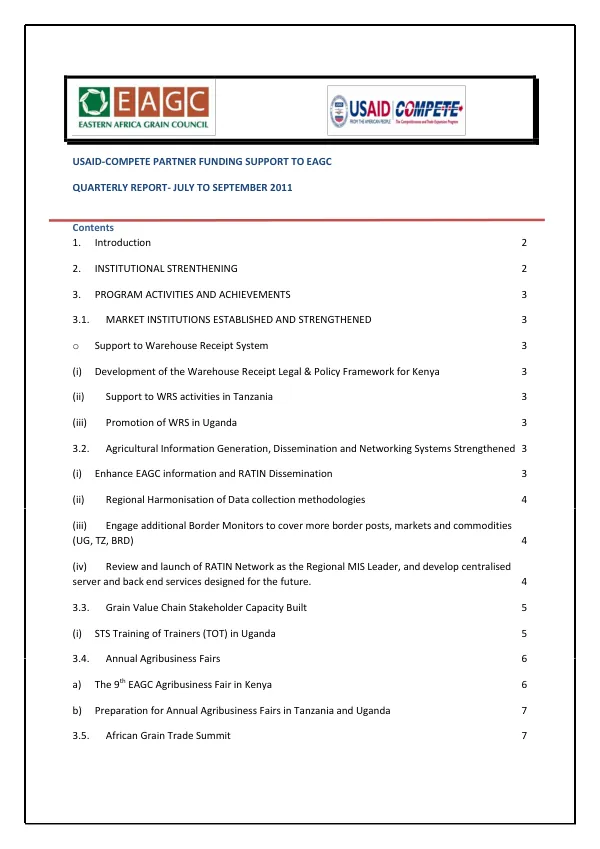
USAID-COMPETE PARTNER FUNDING SUPPORT TO EAGC QUARTERLY REPORT- JULY TO SEPTEMBER 2011
Sign inUSAID DEC
USAID-COMPETE PARTNER FUNDING SUPPORT TO EAGC QUARTERLY REPORT- JULY TO SEPTEMBER 2011
The Eastern Africa Grain Council (EAGC) received funding support from USAID-COMPETE for the period of July to September 2011.
2011 · 8 pages
Sign in to readA free account is required to download.
Abstract
The grant aimed to strengthen institutional coordination and regional structured grain trading systems through integrated regional market information systems, policy, and reduced barriers to trade. The objectives of the grant included facilitating institutional strengthening, formalizing regional agricultural markets, expanding the Regional Agricultural Trade Information Network (RATIN), and holding a successful Grain Trade Summit. EAGC offices in Uganda, Tanzania, and Kenya were operational through the funding support. The council intensified its membership recruitment drive, leading to the registration of EAGC Rwanda chapter. Seven organizations had shown interest in joining the membership, and follow-ups were being made. EAGC also formalized relationships with organizations that would serve as national-level focal points in Uganda and Tanzania. The council established and strengthened market institutions, including the Warehouse Receipt System (WRS). In Kenya, the WRS Task Force submitted its deliverables, including a draft WRS bill, draft rules and regulations, and a summary of transitional issues. Plans were made to hold a validation workshop with stakeholders and submit the WRS bill to the Parliamentary Committee on Agriculture for review and passage. In Tanzania, EAGC partnered with the Tanzania Warehouse Licensing Board to support harmonization of rules and protocols for WRS operations. In Uganda, EAGC and the Uganda Commodity Exchange agreed to jointly promote the use of WRS. EAGC strengthened agricultural information generation, dissemination, and networking systems. The council developed weekly price analysis reports and disseminated them to members and key stakeholders in the region. A database of 2,300 subscribers was maintained, and a system was developed to analyze daily news on the grain sector and send a weekly news roundup to all members and stakeholders. Regional harmonization of data collection methodologies was also undertaken, and additional border monitors were engaged to cover more border posts, markets, and commodities. The council reviewed and launched the RATIN network as the regional MIS leader and developed centralized server and back-end services designed for the future. Plans were made to review RATIN, and a technical staff meeting was held to thoroughly review the process and requirements of upgrading and overhauling the system. EAGC also improved its MIS dissemination channels to various end-users, including the use of SMS, weekly newsletters, quarterly newsletters, radio, TV, newspapers, market boards, and other media. EAGC participated in regional and national-level MIS workshops, including the 2nd MIS workshop in Uganda in partnership with Agri-profocus. The council also signed a Memorandum of Understanding with the team to begin networking and allow for cordial execution of activities to improve access to market information in the region. EAGC participated in a national MIS providers meeting in Bujumbura, Burundi, in conjunction with the Ministry of Agriculture Burundi, Institute of Science and Technology, and ASARECA. During the period, EAGC held meetings and formed national food balance sheet committees to coordinate data collection and input to the national food balance sheet. The committees were hosted by the country's Ministry of Agriculture and EAGC country offices. A meeting was held to support the development of the regional food balance sheet, which aimed to provide a comprehensive picture of food availability and utilization in the region.