RTI INTERNATIONAL
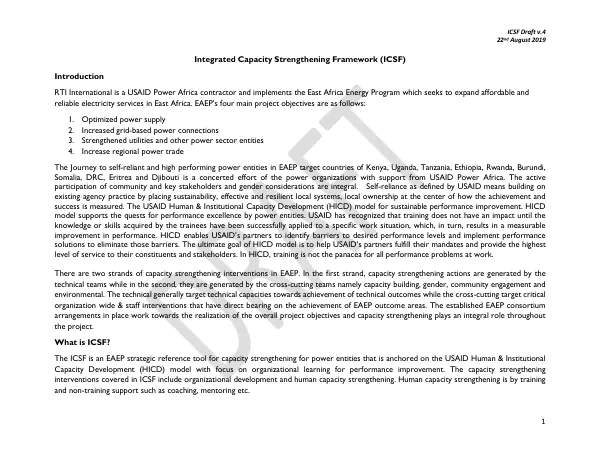
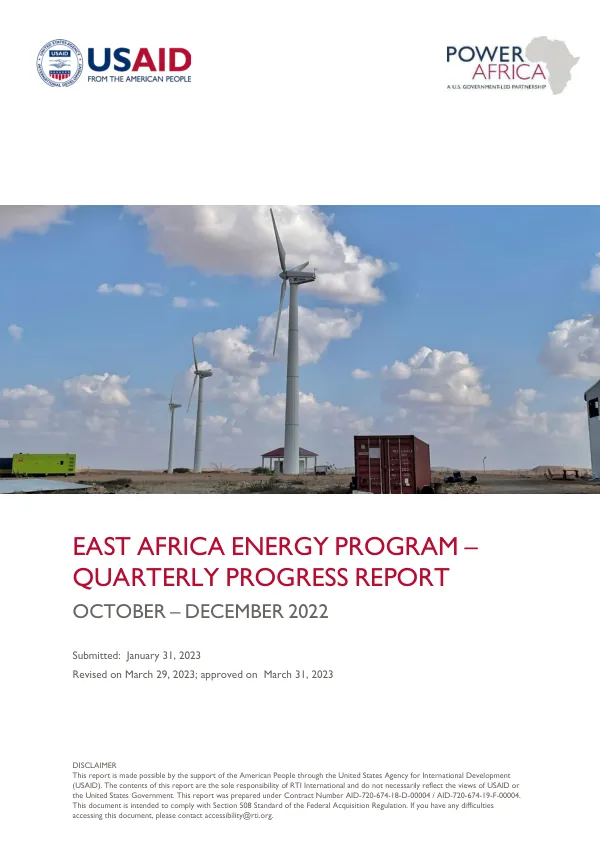
East Africa Energy Program – Quarterly Progress Report October – December 2022
The East Africa Energy Program (EAEP) is a USAID-funded initiative implemented by RTI International to improve the energy sector in East Africa.
2023 · 98 pages
Sign in to readA free account is required to download.
Abstract
The program focuses on four main objectives: Optimized Power Supply, Increased Grid-Based Power Connections, Strengthened Utilities and Other Power Sector Entities, and Increased Regional Power Trade. EAEP works with national energy corporations, utilities, and regulatory bodies to address the region's energy challenges. In the first quarter of fiscal year 2023, EAEP made significant progress in achieving its objectives. In Burundi, the program supported the development of a least-cost power development plan, which aims to increase the country's power generation capacity by 2025. In Kenya, EAEP worked with the Kenya Electricity Generating Company Ltd. (KenGen) to improve the efficiency of its power plants, resulting in a 10% reduction in greenhouse gas emissions. In Rwanda, EAEP supported the implementation of a rural electrification program, which aims to connect 200,000 households to the grid by 2025. The program also worked with the Rwanda Energy Group to develop a renewable energy strategy, which includes the development of solar and wind power projects. In Somalia, EAEP supported the National Energy Corporation of Somalia (NECSOM) in the development of a photovoltaic and wind power plant, which will increase the country's power generation capacity by 20%. EAEP also made progress in strengthening utilities and other power sector entities. In Tanzania, the program worked with the Tanzania Electric Supply Company Ltd. (TANESCO) to improve its operational efficiency, resulting in a 15% reduction in power outages. In Uganda, EAEP supported the development of a public-private partnership framework, which aims to attract private investment in the energy sector. In terms of increased regional power trade, EAEP worked with the East African Power Pool (EAPP) to develop a regional power trade framework, which aims to increase the exchange of power between East African countries. The program also supported the development of a regional energy market, which will enable the free movement of power across the region. EAEP's progress in the first quarter of fiscal year 2023 demonstrates the program's commitment to improving the energy sector in East Africa. The program's achievements are expected to have a positive impact on the region's economic development and energy security. The program's institutional performance improvement unit (IPIU) played a key role in EAEP's progress, providing technical assistance to national energy corporations and utilities. The IPIU also supported the development of institutional capacity development plans, which aim to improve the skills and knowledge of energy sector professionals. EAEP's gender and environment units also made significant progress in the first quarter of fiscal year 2023. The gender unit supported the development of a gender strategy, which aims to increase the participation of women in the energy sector. The environment unit worked with national energy corporations and utilities to develop environmental management and mitigation plans, which aim to reduce the environmental impact of energy projects. EAEP's monitoring, evaluation, and learning (MEL) unit also made significant progress in the first quarter of fiscal year 2023. The MEL unit developed a monitoring and evaluation framework, which aims to track the program's progress and impact. The unit also supported the development of a learning and knowledge management system, which aims to share best practices and lessons learned across the region.
Related documents