USAID DEC
USAID cooperative agreement no. DAN-5117-A-00-9099-00 with Wellstart/San Diego Lactation Program to provide support for lactation management education activities for health professionals from developing countries
Sign inUSAID. BUR. FOR SCIENCE AND TECHNOLOGY. OFC. OF NUTRITION
USAID cooperative agreement no. DAN-5117-A-00-9099-00 with Wellstart/San Diego Lactation Program to provide support for lactation management education activities for health professionals from developing countries
Grant is provided to Wellstart/San Diego Lactation Program to continue its efforts, begun under project 9311010, in lactation management education for health professionals in developing countries.
1989
Sign in to readA free account is required to download.
Abstract
To increase the number of health professionals from developing countries with lactation management expertise, Wellstart will recruit 60 teams (200 health professionals -- obstetricians, pediatrician, midwives, nurses, nutritionists) and train them in clinical management of lactation, breastfeeding problems, maternal/infant nutrition, fertility issues, and promotional strategies. Most, but not all, of the teams will be from teaching hospitals. Wellstart will continue to offer three 4-week courses per year for English-speaking teams, but will add one course for French speakers and one or two for Spanish-speaking teams. Wellstart will strengthen its basic curriculum in such areas as helping working mothers continue breastfeeding, reaching high-risk mothers, and training non-professional health workers. Intervention planning is a critical aspect of the training process. As part of their training, teams will develop detailed action plans for organizing model service and teaching programs in their home institutions. To ensure that they will support such programs, administrative staff of the home institutions will be included in at least a portion of the training. Each team will be provided with a basic collection of teaching materials for use in their own programs. Wellstart will provide TA to the teams in implementing their action plans, including assistance with networking and leadership development. Follow up TA will also be provided, and at least two regional continuing education conferences will be held, most likely in Africa and Central and South America. To ensure that primary health care providers will also receive training, three to five national or regional lactation centers will be established. One of their responsibilities will be to train primary care workers. Four advanced study fellowships will be offered each year to graduates of Wellstart courses who show promise as future directors of lactation centers. Libraries of lactation materials will also be set up at these centers. Finally, an ongoing system of research and program evaluation will be established.
Related documents
Documents in this collection
 1990
1990USAID DEC
AID contract with Management Sciences for Health to promote institutional development and to strengthen the management capabilities of family planning organizations in developing countries
Open record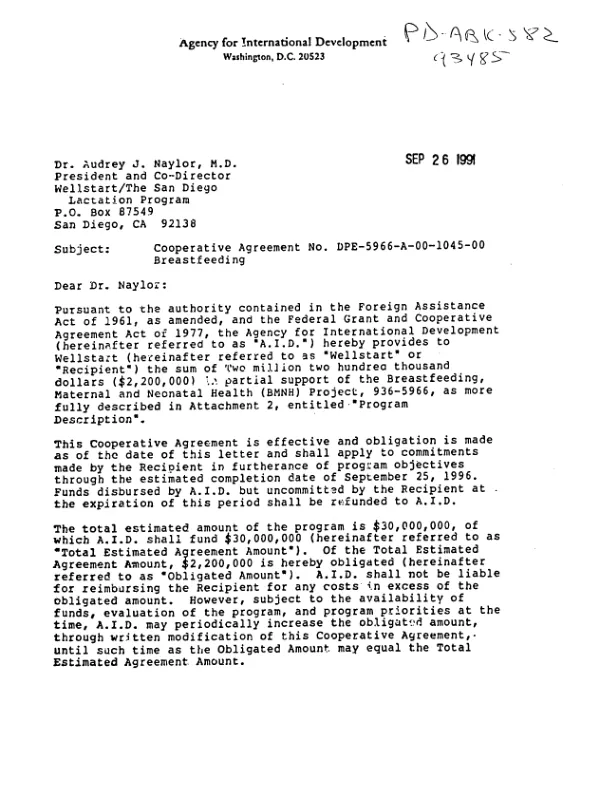 1991
1991USAID DEC
![Analysis of hospital practices and Wellstart associate activities : results from participation in the Wellstart LME [lactation management education] program](https://covers.devme.ai/gen/46322.webp)