INNOVATIONS FOR POVERTY ACTION
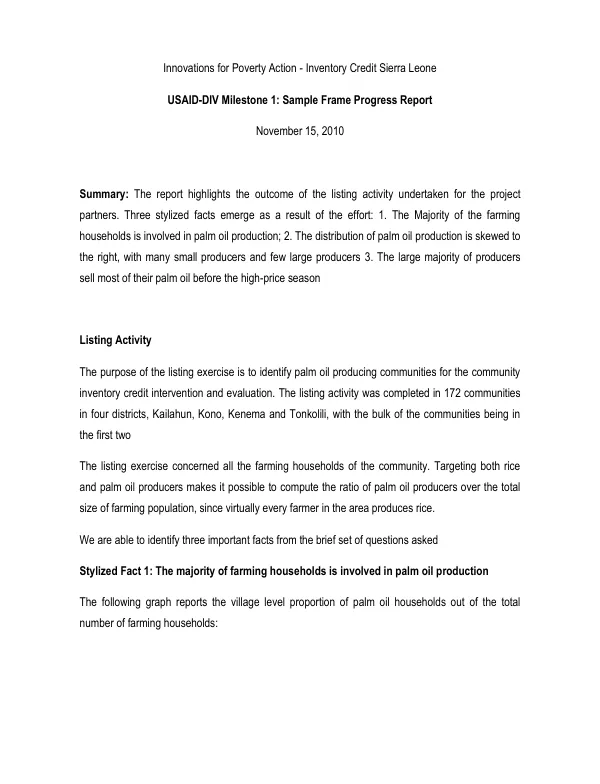
USAID-DIV Milestone 1: Sample Frame Progress Report
The agricultural development initiative in Sierra Leone, led by Innovations for Poverty Action (IPA), focuses on improving the livelihoods of small-scale palm oil producers.
2010 · 54 pages
Sign in to readA free account is required to download.
Abstract
The project aims to increase household income and food security through the provision of inventory credit and other interventions. The listing exercise, conducted in 172 communities across four districts, identified key stylized facts about palm oil production in the region. The majority of farming households (45%) are involved in palm oil production, with a skewed distribution towards small producers and few large producers. The large majority of producers (75%) sell most of their palm oil before the high-price season, which typically occurs after the end of the rainy season. The baseline survey, conducted in January 2011, collected data from 1,869 palm oil producing households across 120 communities. The survey found that agriculture is the primary income source for the target households, with a significant share of households having at least one additional income source. Oil palm is the most important sale crop for the target households, with cacao playing a major role in the catchment areas of Pendembu and Segbwema banks. Palm oil production plays a significant role among the agricultural activities of most target respondents, with 72% of households involved in masankay production and 81% in red palm oil production. The median production level is 11 battas (5-gallon containers), with a mean of 15, while the median volume of total sales is 8 battas, with a mean of 11. The sample includes a handful of very large producers, selling up to 100 battas in the last season. The baseline survey also collected data on household demographics, including household size, religion, ethnicity, education, and income sources. The results show that the target households have a high level of dependence on agriculture, with a significant share of households having at least one additional income source. The survey findings will inform the upcoming intervention and evaluation, which aims to increase household income and food security through the provision of inventory credit and other interventions. The project partners will select 120 communities where the baseline survey will be administered, starting from January 2011. The survey will include detailed questions concerning household composition, farming activity, palm oil production and marketing, risk and inter-temporal preferences, and price expectations. The baseline survey will provide a comprehensive understanding of the target households' characteristics, which will inform the project's interventions and evaluation.