USAID DEC
USAID/Egypt Workforce Improvement and Skill Enhancement Project: Year 4, Quarter 2 Report
Sign inINTERNATIONAL LABOR ORGANIZATION
USAID/Egypt Workforce Improvement and Skill Enhancement Project: Year 4, Quarter 2 Report
The Workforce Improvement and Skill Enhancement (WISE) Project in Egypt began its fourth year of implementation on November 1, 2018.
2019 · 49 pages
Sign in to readA free account is required to download.
Abstract
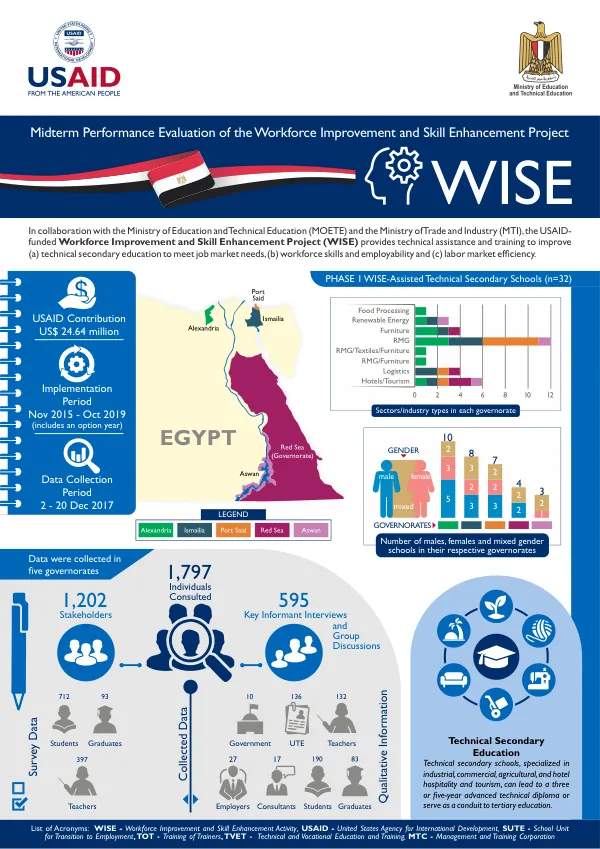
The project supports and collaborates with various public and private sector entities to provide training and capacity building for stakeholders and counterparts. Three result areas are the focus of the project: Result A, which upgrades technical secondary education to meet market needs in selected governorates and sectors; Result B, which improves skills and productivity within the workforce and private sector in selected sectors and governorates; and Result C, which supports an enabling environment for improved labor market efficiency. Result A focuses on upgrading technical secondary education to meet the needs of the market in selected governorates and sectors. Key accomplishments include improving schools' capacity to provide students with technical, practical, entrepreneurial, innovation, and soft skills needed by the market to enhance employability. This was achieved through the development and implementation of curricula that meet international standards and address market needs. Additionally, school governance and management were improved, and innovative and student-centered approaches to technical education were developed and piloted. Result B focuses on improving skills and productivity within the workforce and private sector in selected sectors and governorates. Key accomplishments include upgrading the technical, practical, and soft skills of selected job seekers and linking them to the private sector for employment. Productivity of the existing labor force was also improved, and firms were better able to recruit, retrain, and retain their staff through the 3R Program. Result C focuses on supporting an enabling environment for improved labor market efficiency. Key accomplishments include assisting selected NGOs in developing strategies to advocate for policy reforms related to labor market efficiency. Stakeholders at the governorate level were also supported in addressing identified challenges to labor market efficiency. The project has established strong working relationships with a wide range of partners, including the Ministry of Education and Technical Education, the Federation of Egyptian Industries, the Egyptian National Competitiveness Council, the Ministry of Local Development, and various private sector companies and technical schools across 11 governorates. These relationships are critical to connecting Egypt's businesses and technical schools, as well as for identifying current labor market trends and the types of skills that are in demand. The project's accomplishments in the second quarter of Year 4 demonstrate its continued commitment to improving the workforce and labor market efficiency in Egypt. The project's focus on upgrading technical secondary education, improving skills and productivity, and supporting an enabling environment for improved labor market efficiency has resulted in significant progress towards its goals.
![A guide to preparing planning budgets and operating and maintenance budgets for drinking water and sanitation companies [Arabic]](https://covers.devme.ai/gen/138315.webp)