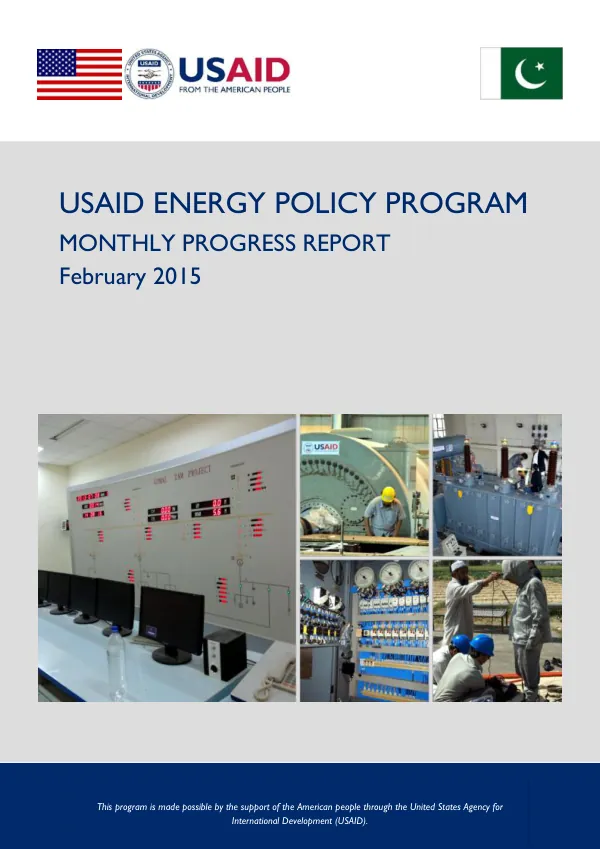
ADVANCED ENGINEERING ASSOCIATES INTERNATIONAL, INC. /SGGA
USAID Energy Policy Program: PowerSIM Aids Pakistan’s Power Sector
The USAID Energy Policy Program (EPP) team developed a tool to address critical needs in Pakistan's power sector.
2015 · 2 pages
Sign in to readA free account is required to download.
Abstract
The Power Sector Integrated Model, known as PowerSIM, is a Microsoft Excel-based policy analysis tool designed to help the Government of Pakistan evaluate policy options and measures aimed at improving the financial efficiency and sustainability of the country's power sector. PowerSIM is used to address a major problem regarding LNG, allowing policymakers to see how small changes impact the overall system, such as consumer prices, circular debt, the cost of generation, and fuel use. The Ministry of Water and Power has used PowerSIM to demonstrate the effects of additional gas supply on the power sector. Currently, EPP is using PowerSIM to develop the Planning Commission's 11th 5-Year Plan, building financial and supply assumptions. Training sessions for senior officials and technical staff at the Ministry of Petroleum and Natural Resources and Ministry of Water and Power were conducted while developing PowerSIM. A total of 11 participants, including one female official, attended the session. The training enabled participants to analyze data, information, and statistics provided by NEPRA and other departments, facilitating informed decision-making. PowerSIM is now being used by the Government of Pakistan to forecast the financial impact of improved performance within existing systems, such as greater efficiency, power generation, and infrastructure additions, fuel substitutions, improved cost recovery, and policy changes. It has facilitated the Ministry of Water and Power and Ministry of Petroleum and Natural Resources to better analyze both energy and cash flow, making informed decisions. PowerSIM has also helped assess the impact of policy changes, including uniform national tariffs and differential tariffs, and the impact of timely fuel payments to Independent Power Producers. The use of PowerSIM has improved the financial efficiency and sustainability of Pakistan's power sector, enabling policymakers to make informed decisions. The tool has facilitated the analysis of energy and cash flow, allowing for better forecasting of the financial impact of policy changes. As a result, PowerSIM has become an essential tool for the Government of Pakistan in its efforts to address the country's energy supply and delivery problems.
Related documents