TETRA TECH
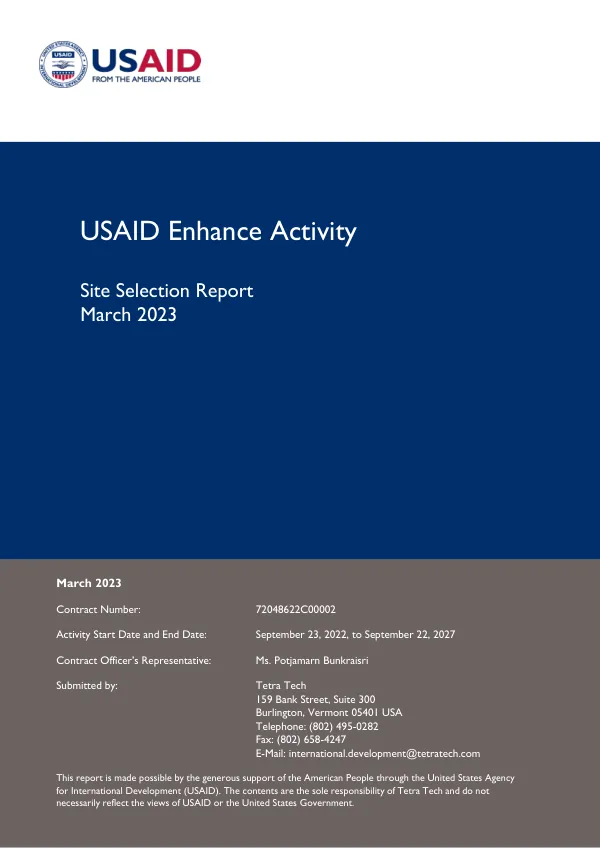
USAID Enhance Activity: Site Selection Report
The USAID Enhance Activity is a five-year initiative funded by USAID/Regional Development Mission for Asia (RDMA) with the goal of strengthening citizen-centric local governance in Thailand.
2023 · 52 pages
Sign in to readA free account is required to download.
Abstract
The Activity aims to strengthen the capacity of local governments and nongovernmental stakeholders in citizen-centric governance, promote communications, networking, and learning among stakeholders, and ensure the adoption and institutionalization of successful local innovations that support citizen-centric governance. The Activity is based on the premise that mutually reinforcing efforts and deeper partnerships between government and nongovernment stakeholders will provide increased opportunities for citizens to participate in government and empower citizens to voice their concerns constructively. Strengthening communications, networking, and learning among government and nongovernmental stakeholders also plays an important role in promoting citizen-centric local governance, including through helping to scale governance innovations to additional regions and localities. Enhance is implemented through USAID Contract Number 72048622C00002 by Tetra Tech, with a period of performance from September 23, 2022, to September 22, 2027. The Activity will be implemented in Thailand nationwide, with local and national audiences in Thailand's Deep South and selected provinces in the North and Northeast. To achieve its objectives, Enhance works with local government organizations, including provincial administrative organizations (PAOs), municipalities, and subdistrict administrative organizations (SAOs). The Activity applies a differentiated approach to deal with the needs of underrepresented groups in these localities to ensure that their concerns, priorities, and experiences are an integral dimension of the design, implementation, monitoring, and evaluation of the Activity. The Site Selection Report presents the methodology through which PAO, municipal, and SAO partners will be selected through an objective and transparent process, including consideration of social and demographic diversity, participation and inclusion, service delivery, and local governance. Enhance will engage its selected partners through regional co-creation activities to work with national and local administrative/elected officials to determine entry points, such as existing platforms for citizen-centric governance, as well as gaps, per legal and statutory requirements, that Enhance can address with support for public consultations and participatory local governance. Enhance proposes an approach to engaging partner sites that thoughtfully phases in new sites over the life of the Activity, as well as creates cogent cohorts. This approach includes inviting high-performing sites to partner in the first year to create a first phase of sites that quickly gains traction on Enhance objectives and begins to demonstrate desired results, and to form a cohort of peer leaders that can offer models and exchange lessons with subsequent selections. The site selection process yields, in the first year and a half (October 2022–March 2024), one province and several municipalities and SAOs. The selection process involves a six-step methodology, including understanding the objectives and scope of the project, developing preliminary screening criteria, collecting and evaluating available data, setting up the INSPR scorecard tool, running the INSPR model to obtain preliminary results, and assessing local government organizations for final selection. The Activity will engage its selected partners through regional co-creation activities to work with national and local administrative/elected officials to determine entry points, such as existing platforms for citizen-centric governance, as well as gaps, per legal and statutory requirements, that Enhance can address with support for public consultations and participatory local governance. Enhance will work with relevant local Thai partners, including CSOs, universities, and learning centers, to co-create and implement training curricula, event programs, mentoring approaches, and related interventions beginning in the first year as well as in subsequent years. The Activity will apply a differentiated approach to deal with the needs of underrepresented groups in these localities to ensure that their concerns, priorities, and experiences are an integral dimension of the design, implementation, monitoring, and evaluation of the Activity. This approach includes creating cohorts of peer leaders that can offer models and exchange lessons with subsequent selections, and phasing in new sites over the life of the Activity to create a first phase of sites that quickly gains traction on Enhance objectives and begins to demonstrate desired results.