CHEMONICS
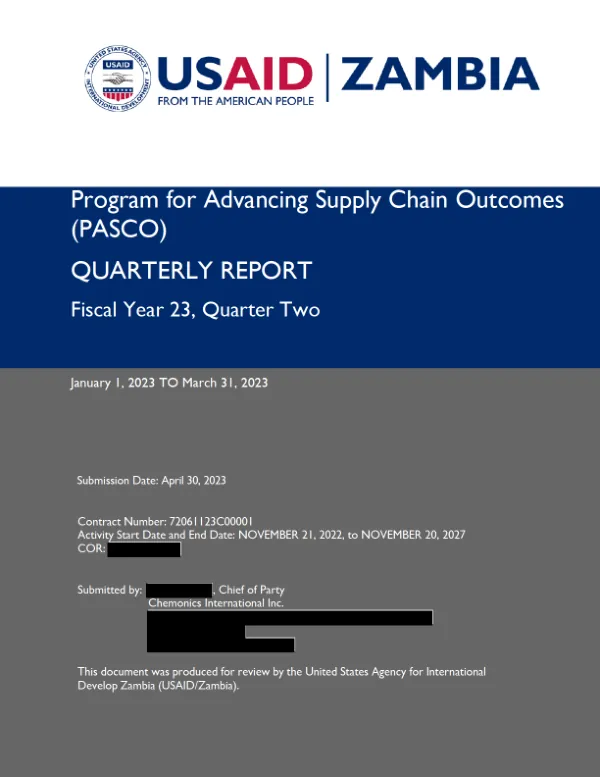
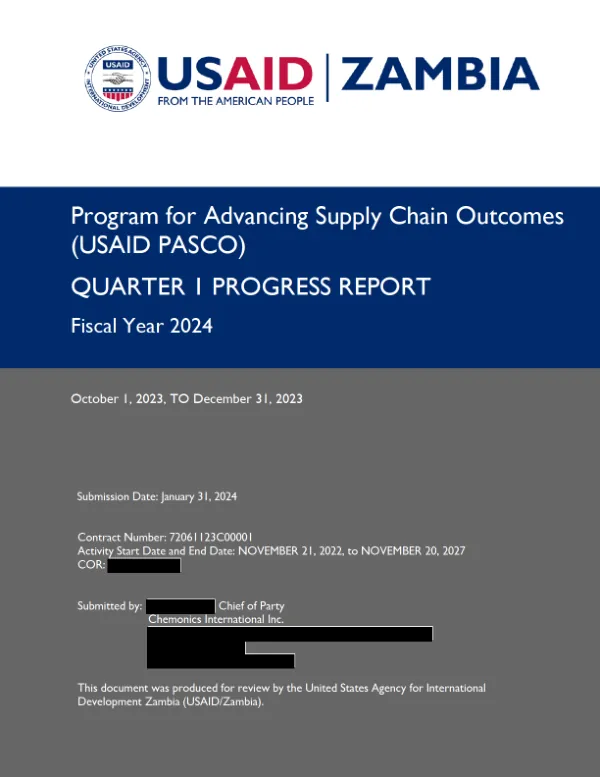
USAID PASCO ZAMBIA, QUARTER 1 PROGRESS REPORT, FISCAL YEAR 2024
The Promoting Advanced Supply Chain Outcomes (USAID PASCO) project in Zambia aims to enhance the use of private sector, third-party logistics (3PL) providers in the country's national health supply chain.
2024 · 16 pages
Sign in to readA free account is required to download.
Abstract
The project, which began on November 21, 2022, and is set to end on November 20, 2027, is implemented by Chemonics International Inc. and has a subcontractor, Connexi. The project's primary counterpart organizations are the Zambia Medicine and Medical Supplies Agency (ZAMMSA) and the Ministry of Health (MOH). The project's overarching objectives are to improve the effectiveness and efficiency of the distribution and transportation system, and to identify technical assistance and management components of the transportation and distribution system that can be transitioned and supported by other donors and the Government of the Republic of Zambia (GRZ) by the end of the project. In the first quarter of fiscal year 2024, USAID PASCO supported the distribution of 54 percent of the total volume of health commodities in the national system and 52 percent of kilometers covered from ZAMMSA central and the four PASCO-supported hubs. The project enhanced the distribution framework initially developed in fiscal year 2023 to incorporate revised process maps that included order reviews for restricted products not intended for distribution through United States Government (USG)-funded distribution mechanisms. The project also continued to use the dispatch and route optimizer (DRO) to develop distribution plans for health commodities. During the first quarter, the project worked with ZAMMSA and the Global Health Supply Chain Procurement-Supply Management (GHSC-PSM) to enhance the DRO to integrate with the latest version of OpenStreetMaps, increase the number of facilities and accuracy of GIS coordinates, align with expanded subcontracting terms that include additional vehicle sizes, and add separate optimization functionalities that consider the unique parameters of 3PL and direct ZAMMSA fleet. The project's efforts to optimize distribution planning resulted in a 23 percent increase in vehicle utilization and a reduction in the number of vehicles on the road, resulting in a 32 percent cost savings and a reduction in total kilometers covered. The project also ensured the safety and environmental integrity of health commodities by conducting inspections on 3PL vehicles, guiding new vendors on proper segregation and transportation, and promoting eco-driving practices. In addition to its logistics and distribution management efforts, USAID PASCO collaborated with the Zambia Monitoring, Evaluation, and Learning Platform (ZMELP) on third-party monitoring activities, including vehicle inspection data quality assessments, context monitoring, and provided weekly delivery data feeds. The project also attended two GHSC-PSM-supported Regional Supply Chain Review Meetings in Lusaka and Western provinces, enhancing data utilization for decision-making, presenting distribution data and last-mile 3PL support to ZAMMSA, and introducing the PASCO incident reporting tool for continuous improvement and accountability. The project's HIV prevention efforts included signing a Memorandum of Understanding (MoU) with the CHEKUP I project, expanding coverage to Copperbelt province, and renewing its MoU with CHEKUP II, covering Lusaka and Mpika provinces, to continue integrated HIV/AIDS health services targeting underserved 3PL driver populations. The project also requested support for HIV workplace policy development or revision for the new 3PL vendors. Overall, the USAID PASCO project in Zambia has made significant progress in enhancing the use of private sector, 3PL providers in the country's national health supply chain, improving the effectiveness and efficiency of the distribution and transportation system, and identifying technical assistance and management components of the transportation and distribution system that can be transitioned and supported by other donors and the GRZ.
Related documents