USAID
USAID Facilitating Public Investment Project
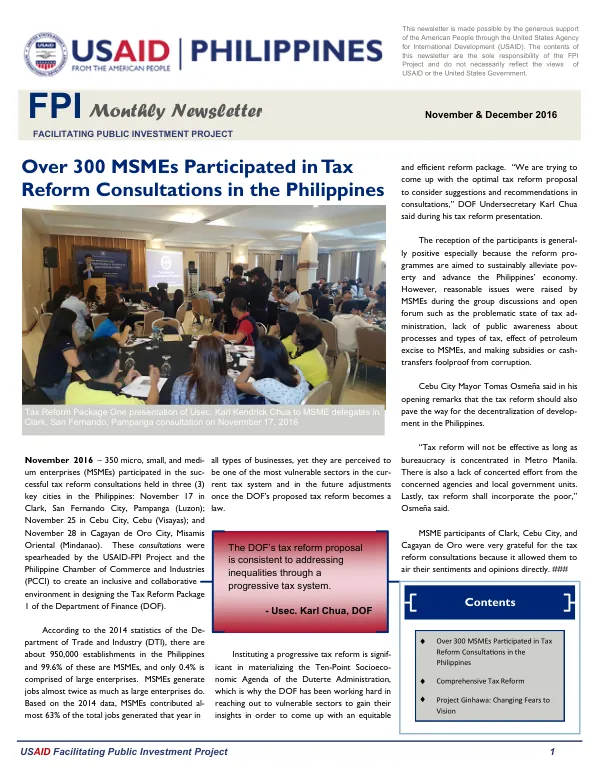
The Facilitating Public Investment Project (FPI) was a collaborative effort between the USAID-FPI Project and the Philippine Chamber of Commerce and Industries (PCCI) to facilitate public investment in the Philippines.
2016 · 4 pages
Sign in to readA free account is required to download.
Abstract
The project's primary objective was to promote inclusive and equitable economic growth by reforming the country's tax system. In November 2016, the USAID-FPI Project and PCCI organized a series of tax reform consultations in three key cities in the Philippines: Clark, San Fernando City, Pampanga (Luzon); Cebu City, Cebu (Visayas); and Cagayan de Oro City, Misamis Oriental (Mindanao). Over 300 micro, small, and medium enterprises (MSMEs) participated in these consultations, which aimed to create an inclusive and collaborative environment in designing the Tax Reform Package 1 of the Department of Finance (DOF). The DOF's proposed tax reform package, known as the Tax Reform for Acceleration and Inclusivity (TRAIN), aimed to address inequalities through a progressive tax system. The package included reductions on personal income tax (PIT) for low- to mid-income earners, which would increase take-home pay and encourage savings and investments. The proposed tax system would also have a simpler, fairer, and more efficient tax system characterized by low rates and a broad base that could promote investment, job creation, and poverty reduction. The DOF's tax reform package identified measures to accelerate revenue collection, including an expansion of the Value Added Tax (VAT) base, increasing excise on petroleum and index to inflation, and increasing excise on automobiles. The package also proposed to reduce the PIT maximum rate to 25% over time, except for the country's "ultra-rich" to maintain progressivity. The Tax Administration Reform Act (TARA), also known as the "Ease of Paying Taxes Act," was proposed by Cong. Joey Salceda, vice chair of the House Committee on Economic Affairs. The bill aimed to institutionalize measures that would improve the tax environment, assure compliant taxpayers protection against abuse, and make the tax administration more efficient and effective. The USAID-FPI Project provided deep technical support to the DOF and their champions at the House of Representatives, including accurate and reliable data gathering, analysis, and campaign strategies. The project worked with private sector and civil society partners, such as Action for Economic Reforms (AER), Tax Management Association of the Philippines (TMAP), and Philippine Chamber of Commerce and Industries (PCCI), to lobby for the reforms. The proposed tax reform bills, including TRAIN and TARA, aimed to fulfill the Administration's vision of reducing poverty to a single digit and improving the economy by 9%, making the Philippines the 4th economic giant in Asia after South Korea, Japan, and China. The bills also aimed to address the country's huge budget deficit, which had been a persistent issue since 1997.