DEPARTMENT OF AGRICULTURE
Feed the Future at a Glance: Tajikistan
Feed the Future, the U.S.
2012 · 2 pages
Sign in to readA free account is required to download.
Abstract
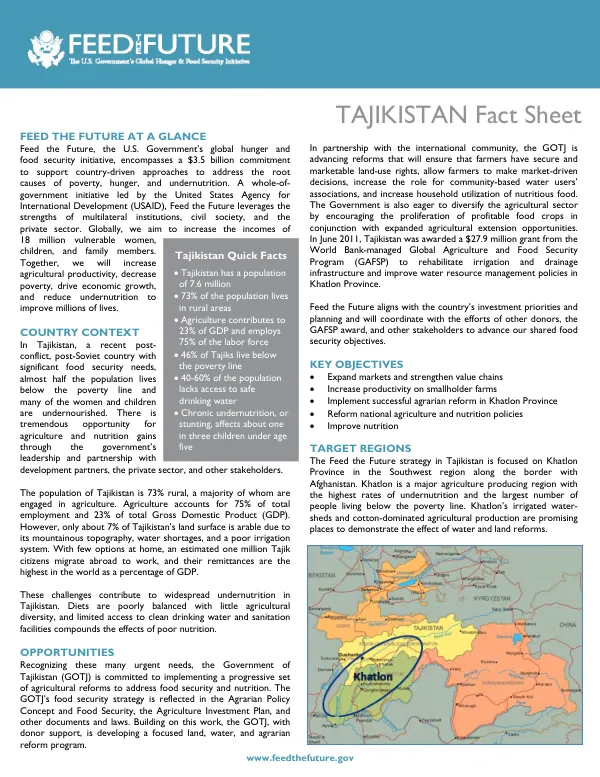
Government's global hunger and food security initiative, encompasses a $3.5 billion commitment to support country-driven approaches to address the root causes of poverty, hunger, and undernutrition. A whole-of-government initiative led by the United States Agency for International Development (USAID), Feed the Future leverages the strengths of multilateral institutions, civil society, and the private sector. The initiative aims to increase the incomes of 18 million vulnerable women, children, and family members globally. In Tajikistan, a post-conflict, post-Soviet country with significant food security needs, almost half the population lives below the poverty line, and many women and children are undernourished. The population of Tajikistan is 73% rural, with agriculture accounting for 75% of total employment and 23% of total Gross Domestic Product (GDP). However, only about 7% of Tajikistan's land surface is arable due to its mountainous topography, water shortages, and a poor irrigation system. The Government of Tajikistan (GOTJ) is committed to implementing a progressive set of agricultural reforms to address food security and nutrition. The GOTJ's food security strategy is reflected in the Agrarian Policy Concept and Food Security, the Agriculture Investment Plan, and other documents and laws. Building on this work, the GOTJ, with donor support, is developing a focused land, water, and agrarian reform program. The program aims to ensure that farmers have secure and marketable land-use rights, allow farmers to make market-driven decisions, increase the role for community-based water users' associations, and increase household utilization of nutritious food. Feed the Future in Tajikistan will focus on three pillars: assisting household and small commercial farms to increase income and food production for home consumption and improve nutrition and health outcomes; developing capacity of local institutions and community-based organizations; and completing effective agrarian reforms in selected districts in Khatlon Province. The initiative will also focus on developing fruit and vegetable value chains in Tajikistan, which have the greatest potential for enabling rural households to increase incomes, afford more adequate and nutritious food, and produce more nutritious food for direct household consumption. Undernutrition among women and children in Tajikistan is a serious public health problem contributing to maternal and child mortality and perpetuating the cycle of poverty and hunger. Feed the Future will invest in a combination of food-based inputs and high-impact nutrition interventions, targeted health services, and social and behavior change communication, as well as activities to improve access to safe drinking water and improved sanitation and hygiene. Effective agrarian reform at the local and national level is a critical element of Feed the Future's investments in Tajikistan, including changes in land and water relations and rights, institutions, policies, and incentives. Feed the Future is committed to developing the capacity of local institutions and community-based organizations. The strategy in Tajikistan will support agricultural extension systems to advise farm households on production techniques, natural resource conservation, nutrition, and the formation of producer groups to facilitate access to inputs and markets. Feed the Future will also support village organizations, particularly women's groups, by providing advisory services that help empower rural residents to tackle local development challenges themselves.
Related documents