DEVTECH SYSTEMS, INC.
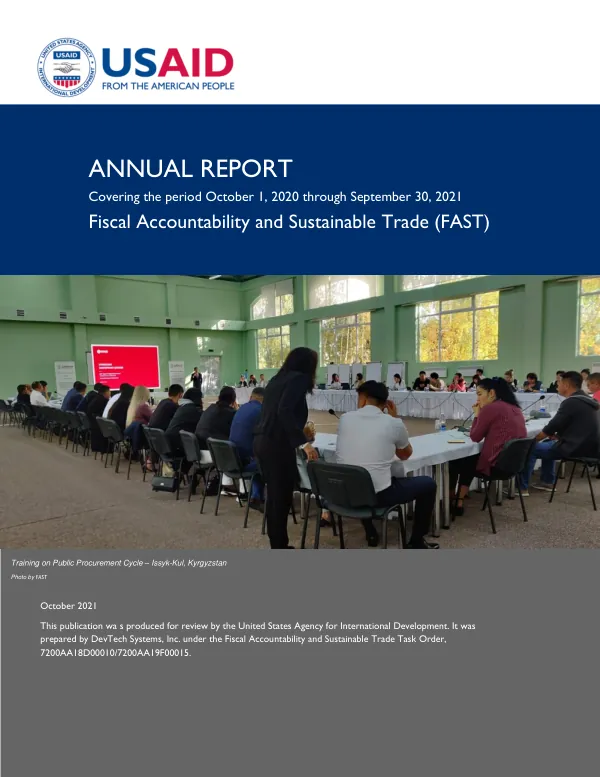
USAID Fiscal Accountability and Sustainable Trade, Annual Report, October 2021
The Fiscal Accountability and Sustainable Trade (FAST) program is a contractual mechanism that enables USAID/Washington and Missions to rapidly respond to urgent needs for analysis, assessment, and knowledge sharing and building.
2021 · 39 pages
Sign in to readA free account is required to download.
Abstract
FAST activities can range from short-duration projects to multiyear engagements. The program focuses on strengthening public financial management, trade capacity building, and economic growth in partner countries. During the period from October 1, 2020, to September 30, 2021, FAST implemented several key activities. Technical leadership was a primary focus, with the development of a Macroeconomic Resilience Dashboard and a FSR Tracker. These tools aimed to enhance understanding of leading practices and tools in the field of public financial management. Economic growth training was also conducted, with a focus on building capacity in partner countries. The program also supported public financial management for payment for ecosystem services, with a focus on strengthening domestic resource mobilization in Sudan. Procurement reform in Kyrgyzstan was another key area of focus, with the development of recommendations for improving the country's procurement system. In Bangladesh, a tax modernization assessment was conducted, with a focus on improving the country's tax system. Progress against planned targets was also a key area of focus for the program. The program's Monitoring, Learning, and Evaluation (MEL) framework was used to track progress against key indicators. The program's deliverables schedule and status were also closely monitored, with a focus on ensuring that all activities were completed on time and within budget. The program's activities were implemented in several countries, including Sudan, Kyrgyzstan, Bangladesh, and Kenya. The program's technical leadership results were also closely monitored, with a focus on ensuring that the program's activities were aligned with the needs of partner countries. The program's recommendations for improving public financial management and trade capacity building were also closely monitored, with a focus on ensuring that they were implemented effectively. The program's activities were supported by a range of stakeholders, including USAID/Washington and Missions, partner countries, and civil society organizations. The program's progress was also closely monitored by the program's management and reporting team, with a focus on ensuring that the program's activities were aligned with the needs of partner countries. The program's Macroeconomic Resilience Dashboard and FSR Tracker were key tools in the program's technical leadership efforts. These tools aimed to enhance understanding of leading practices and tools in the field of public financial management. The program's economic growth training was also a key area of focus, with a focus on building capacity in partner countries. The program's public financial management for payment for ecosystem services activity was implemented in Sudan, with a focus on strengthening domestic resource mobilization. The program's procurement reform activity was implemented in Kyrgyzstan, with a focus on improving the country's procurement system. The program's tax modernization assessment was implemented in Bangladesh, with a focus on improving the country's tax system. The program's Monitoring, Learning, and Evaluation (MEL) framework was used to track progress against key indicators. The program's deliverables schedule and status were also closely monitored, with a focus on ensuring that all activities were completed on time and within budget. The program's technical leadership results were also closely monitored, with a focus on ensuring that the program's activities were aligned with the needs of partner countries.
Related documents