USAID DEC
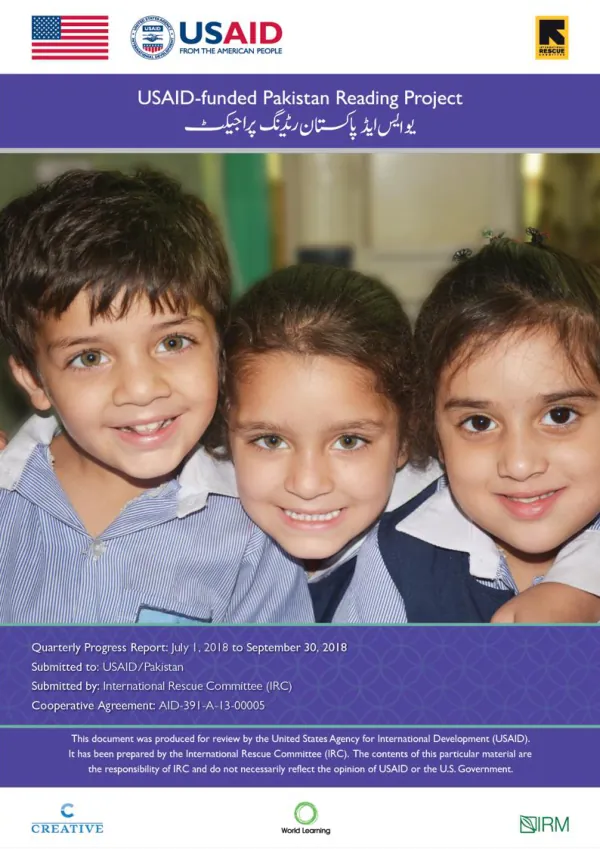
USAID-funded Pakistan Reading Project - Quarterly Progress Report – July 2018 – September 2018
Sign inINTERNATIONAL RESCUE COMMITTEE
USAID-funded Pakistan Reading Project - Quarterly Progress Report – July 2018 – September 2018
The USAID-funded Pakistan Reading Project (PRP) is a comprehensive initiative aimed at improving the quality of education in Pakistan, with a specific focus on enhancing the reading skills of over 1.3 million children in grades one and two.
2018 · 40 pages
Sign in to readA free account is required to download.
Abstract
The project operates in 69 districts across the country, targeting 23,800 teachers in public schools and 111 teacher education institutions. To achieve its objectives, PRP employs a three-pronged approach: teacher training, policy reform, and community support for reading. The project's professional development model emphasizes face-to-face training, with all teachers attending a 5-day training session in the first year and a 3-day refresher course in the second year. Additionally, PRP provides condensed training for newly transferred or inducted grade 1 and 2 teachers. During the reporting quarter, PRP trained 657 teachers, bringing the total number of teachers trained to 24,299. The project also trained 1,657 government officials, including 11 mentors, 79 academic supervisors, and 1,567 head teachers, with a total of 10,166 mentors, academic supervisors, and head teachers trained by the end of the quarter. PRP continued to distribute Reading Learning Materials (RLMs) to schools, providing daily reading lesson plans, workbooks, big books, level readers, flashcards, syllable charts, library books, and other materials. During the reporting quarter, the project distributed 50,618 copies of RLMs, bringing the total number of copies distributed to 5,254,725 by the end of September 2018. The project also conducted two workshops for material development in Balochi, Brahvi, Sindhi, and Pashto, resulting in the development of 24 Big Book stories and exercises for 24 weeks of the academic cycle. To support teachers in their professional development, PRP organized Teacher Inquiry Groups (TIGs) and coaching visits. During the reporting quarter, 7,969 teachers from Cohort 1 and 2 attended TIG meetings, while Cohort 3 teachers attended monthly TIGs. The project's efforts have yielded positive results, with a significant increase in the number of teachers trained and RLMs distributed. The project's focus on teacher training, policy reform, and community support for reading has contributed to improved reading skills among children in grades one and two.