USAID DEC
USAID-funded Yemen Gateway project: Empowering Fathers and Mothers' Councils to Support Education in Yemen
Sign inCREATIVE ASSOCIATES INTERNATIONAL INC.
USAID-funded Yemen Gateway project: Empowering Fathers and Mothers' Councils to Support Education in Yemen
The USAID-funded Yemen Gateway project, implemented by Save the Children in partnership with Creative Associates, aimed to improve school management and participation in Yemen.
4 pages
Sign in to readA free account is required to download.
Abstract
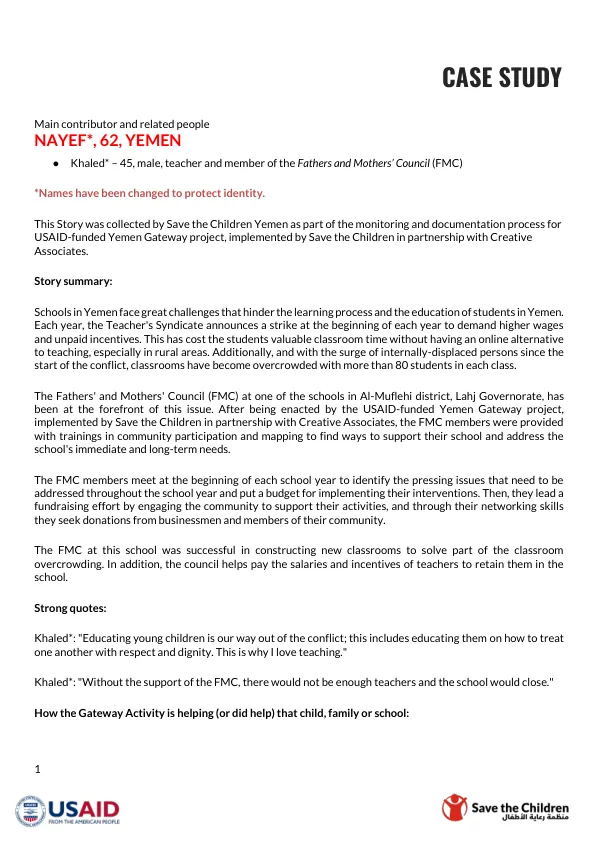
The project focused on building the capacities of Fathers and Mothers' Councils (FMCs) in community engagement and community mapping to support school development and disaster risk reduction. In the Al-Muflehi district of Lahj Governorate, the FMC at a local school was at the forefront of addressing pressing issues. The council, led by Khaled, a 45-year-old teacher, identified the need to construct new classrooms to alleviate overcrowding. With the support of the USAID-funded Yemen Gateway project, the FMC was able to raise funds and build three new classrooms on the third floor of the school. The FMC also collaborated with other schools in the village to hire new teachers and pay incentives for existing teachers to retain them in the school. As a result, the school was able to increase its teacher count to 50, with 75% of them hired by the FMC. The council also paid around Yemeni Rials to teachers annually to raise their salary to an acceptable wage. In addition to addressing teacher shortages, the FMC also tackled other pressing issues, including the lack of textbooks. To solve this problem, the council printed textbooks for students to use in a collaborative way, establishing a small library where students could check out books and return them for others to use. The USAID-funded Yemen Gateway project provided essential school supplies, including stationery, classroom boards, markers, student desks, and hygiene items, to the targeted schools. The project also trained FMC members in school development planning and disaster risk reduction, and provided micro grants to execute their plans. The project's interventions aimed to support the educational process in Yemen, particularly in areas where schools face significant challenges. By building the capacities of FMCs and providing them with the necessary resources and training, the project aimed to improve school management and participation, ultimately contributing to the education and well-being of Yemeni children. The FMC's efforts were driven by a strong sense of community and a commitment to supporting the education of children. As Khaled stated, "Educating young children is our way out of the conflict; this includes educating them on how to treat one another with respect and dignity. This is why I love teaching." The FMC's success in addressing pressing issues and improving the educational process in the school serves as a model for other communities in Yemen.
Related documents