DAI
USAID GOVERNANCE, HUMAN RIGHTS AND DEMOCRACY PROGRAM
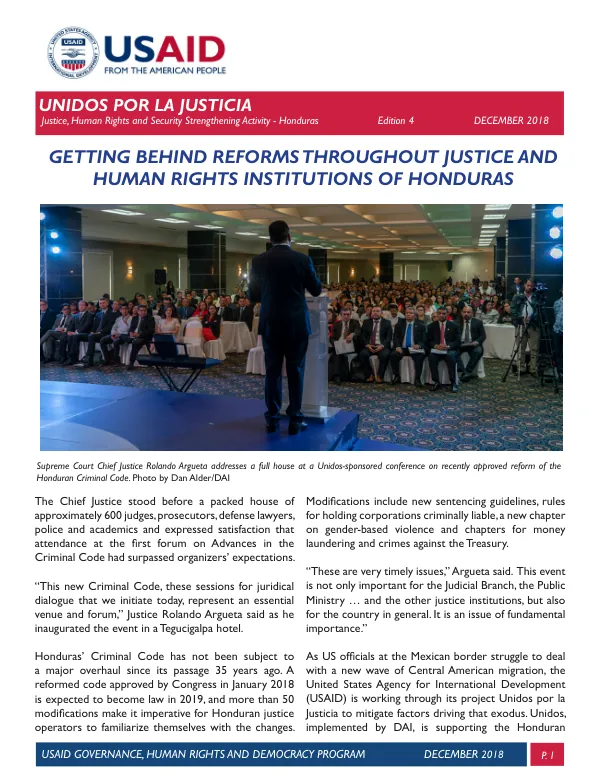
The Honduran government has approved a new Criminal Code, which includes 35 major modifications.
2018 · 5 pages
Sign in to readA free account is required to download.
Abstract
The code introduces new sentencing guidelines, rules for holding corporations criminally liable, and chapters on gender-based violence, money laundering, and crimes against the Treasury. The new code is expected to become law in 2019. The Judicial Branch of Honduras has not undergone a major overhaul of its Criminal Code in 35 years. The new code is expected to improve the country's justice system and strengthen the rule of law. The Judicial Branch has been working with international experts to implement the new code and has established a Human and Institutional Capacity Development (HICD) assessment to identify areas for improvement. The Public Defenders Office (PDO) is also undergoing reforms, with a separate assessment to be conducted to identify areas for improvement. The PDO's 30-year-old regulatory framework is being updated, and public defenders will receive capacity building training. The Human Rights Ministry has been established, and Unidos is supporting the ministry's efforts to create a Human Rights Observatory with broad participation from civil society. The project is also working to improve the relationship between the National Police and urban communities. The National Police has been carrying out activities in high-crime areas, including community fairs, community policing, and beautification campaigns. These activities have resulted in improved relations between the police and the community, with over 18,000 people participating in the activities. The National Police has also adopted a new Community Policing Model, which engages both the police and the community in improving security. The model has been implemented in several communities, including Villa Nueva, where community leaders have been trained in leadership, human rights, and human rights advocacy. The project has also supported the establishment of a Human Rights Observatory, which will provide a platform for civil society to participate in the promotion and protection of human rights. The project has also focused on improving the relationship between the police and marginalized communities. The National Police has been working with community leaders to organize community fairs, community policing, and beautification campaigns. These activities have resulted in improved relations between the police and the community, with over 18,000 people participating in the activities. The project has also supported the establishment of a Human Rights Observatory, which will provide a platform for civil society to participate in the promotion and protection of human rights. The observatory will be responsible for monitoring and reporting on human rights issues in Honduras. The project has also worked to improve the relationship between the police and people with disabilities. The National Police has been working with advocacy organizations to identify barriers to access to the justice system and to develop strategies to address these barriers. The project has also supported the establishment of a Human Rights Observatory, which will provide a platform for civil society to participate in the promotion and protection of human rights. The project has also worked to improve the relationship between the police and at-risk youth. The National Police has been working with community leaders to organize community fairs, community policing, and beautification campaigns. These activities have resulted in improved relations between the police and the community, with over 18,000 people participating in the activities.