DAI GLOBAL, LLC
Justice, Human Rights, and Security Strengthening Activity Quarterly Report #20
The Justice, Human Rights, and Security Strengthening Activity (JHRSS) in Honduras, also known as Unidos por la Justicia, has made significant progress in its efforts to foster a more effective and transparent administration of justice.
2021 · 138 pages
Sign in to readA free account is required to download.
Abstract
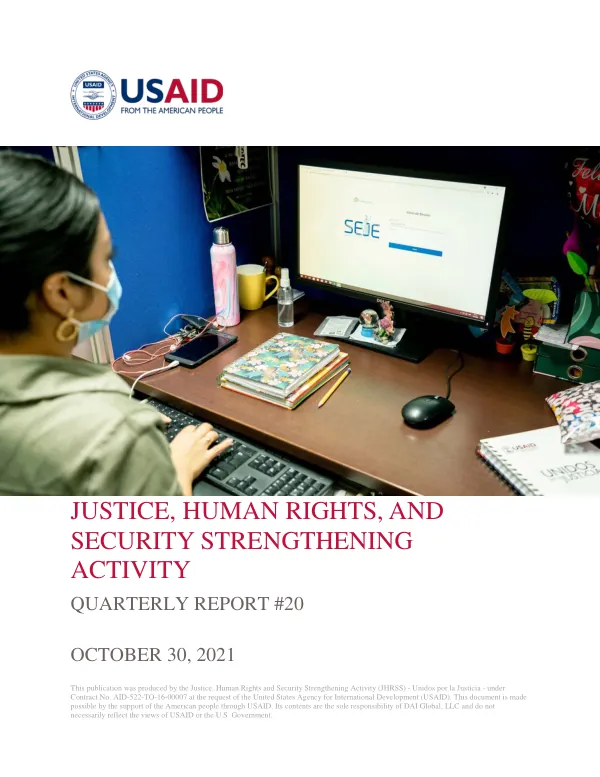
One notable achievement is the official public launch of the USAID-backed Electronic Judicial Case File System (SEJE) in Honduras. This system allows prosecutors to file cases digitally from their offices for the first time, increasing efficiency and access to justice. After almost four years of sustained effort with the Judicial Branch, Unidos ensured that the system is backed by a legal framework, an administrative oversight structure, and a well-defined expansion plan. The implementation of the Electronic Judicial Case File System has been a major milestone for the Judicial Branch, and Unidos has played a crucial role in its development. The system is designed to increase efficiency and transparency in the administration of justice, and it has the potential to make a significant impact on the lives of Hondurans. By providing a digital platform for prosecutors to file cases, the system reduces the risk of errors and increases the speed of the justice process. In addition to the Electronic Judicial Case File System, Unidos has also made significant progress in its efforts to strengthen the multi-sector response to violence against women. The Critical Path for Attending to Violence Against Women is a programmatic area that Unidos developed through the application of USAID's Local Systems framework. This program aims to address the deficiencies in the state's response to gender-based violence (GBV) and to foster a more effective and coordinated response to GBV. Unidos has worked with civil society advocates and justice operators to identify weaknesses in the response to GBV and to prescribe corrective measures. The organization has also worked with the National Police (PN) to foster an initiative to establish gender offices in police stations and to promote the use of Gesell chambers. Furthermore, Unidos has supported the promotion of a six-module course on preventing and responding to GBV in the workplace, which drew 256 business professional participants. The promotion of this course is an important step in raising awareness about the importance of preventing and responding to GBV in the workplace. By providing training and resources to business professionals, Unidos aims to empower companies to take a proactive role in preventing and responding to GBV. This is an important step in addressing the root causes of GBV and in promoting a more just and equitable society. In addition to its efforts to strengthen the multi-sector response to violence against women, Unidos has also continued its support for the implementation of the National Community Police Service Model (MNSPC). This model aims to improve security in marginalized urban neighborhoods by empowering police to work more closely with the community. By providing training and resources to police officers, Unidos aims to empower them to take a more proactive role in preventing and responding to violence in these neighborhoods. The implementation of the MNSPC has been a major focus of Unidos' efforts in recent months. The organization has worked closely with the National Police (PN) to provide training and resources to police officers and to support the establishment of community police stations. By empowering police to work more closely with the community, Unidos aims to improve security in marginalized urban neighborhoods and to promote a more just and equitable society. Overall, the Justice, Human Rights, and Security Strengthening Activity (JHRSS) in Honduras has made significant progress in its efforts to foster a more effective and transparent administration of justice. The organization's work on the Electronic Judicial Case File System, the Critical Path for Attending to Violence Against Women, and the National Community Police Service Model has the potential to make a significant impact on the lives of Hondurans and to promote a more just and equitable society.