HEALTH POLICY PLUS
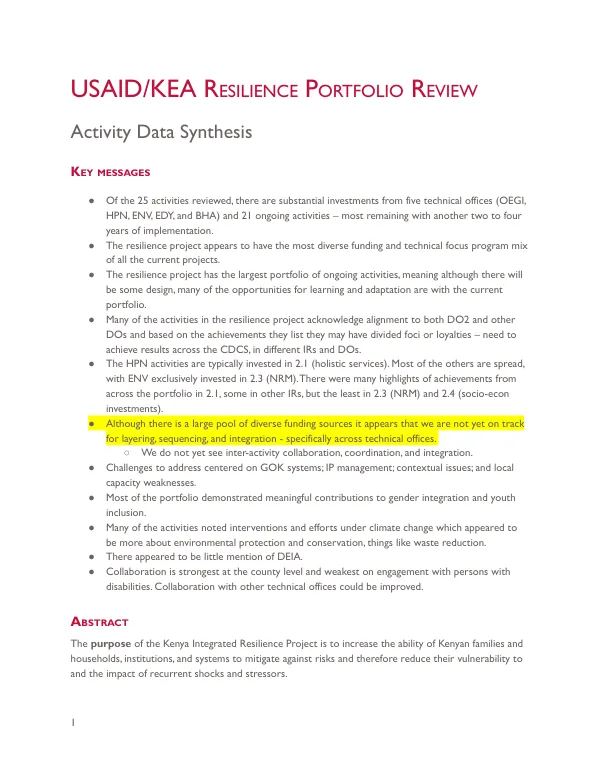
USAID/KEA Regional Portfolio Review: Activity Data Synthesis
The USAID/KEA Regional Portfolio Review Activity Data Synthesis aims to enhance the capacities of focus counties and national government, civil society organizations, communities, and the private sector in Kenya to optimize cross-border, regional, and continental opportunities and mitigate external risks.
2024 · 10 pages
Sign in to readA free account is required to download.
Abstract
The project seeks to strengthen preparedness and resilience to transboundary threats and shocks, improve trade conditions and the economic transformation of young people and women, enhance food distribution and security, and catalyze cross-border cooperation to detect and disrupt transnational conflict, organized crime, and violent extremism. The project's purpose is to leverage Kenya's regional opportunities and mitigate external risks. However, the review notes that the project's activities do not appear to be organized around a concerted effort towards a single purpose. The project has not yet demonstrated its efforts under IR 4.2, cross-border cooperation on security, preventing GBV, and countering VE. The review also highlights that the project's results are often directed at both Kenya and cross-border issues, making it challenging to focus on trans-border issues. The project consists of five ongoing activities, including the Core Group Polio Project, Community Epidemic and Pandemic Preparedness Program, One Health Workforce Activity, East Africa Energy Program, and Kenya Crops and Dairy Market Systems. These activities have made significant accomplishments in various areas, including strengthening the capability to prevent and respond to transboundary threats and shocks, cross-border cooperation on issues such as internal security, conflict, gender-based violence, violent extremism, and governance, and increasing Kenya's trade and investment within the region and beyond. The Core Group Polio Project has conducted community-based surveillance and risk communication, resulting in nearly 1 million people receiving social mobilization messages on polio and other maternal and child health topics in FY2021. The Community Epidemic and Pandemic Preparedness Program has conducted community-based surveillance and risk communication, community engagement, and community dialogue sessions, reaching over 19,000 people. The One Health Workforce Activity has held a workshop on pandemic preparedness and response, sensitized school children and teachers on One Health, and trained 105 in- and pre-service professionals on risk analysis. The East Africa Energy Program has facilitated the addition of 724,952 new electricity connections in Kenya and the commission of 100 megawatts of new clean, reliable power generation in Kipeto and Kajiado County. The Kenya Crops and Dairy Market Systems Activity has leveraged $18.4 million in private sector investment and USG commitment through grants, reached 217,970 individuals who benefited from agricultural productivity and market linking interventions, and supported 173,940 individuals in adopting improved technologies and management practices on 43,676 hectares of land. The project has also faced various implementation, management, and operational issues, including COVID-19 restrictions, vaccine supply and distribution challenges, policy roadblocks, and partner contributions. The project has developed a gender policy and action plan to address gender integration in planning, policy development, program implementation, and program evaluation. The East African Energy Program has supported opportunities for female graduates in the utilities and other energy sector companies and developed gender equity strategies and implementation plans.