CARDNO EMERGING MARKETS USA, LTD.
USAID Kosovo Compete Activity—Sector Action Plans
The USAID/Kosovo Compete Activity is a five-year initiative that began on August 11, 2020.
2021 · 132 pages
Sign in to readA free account is required to download.
Abstract
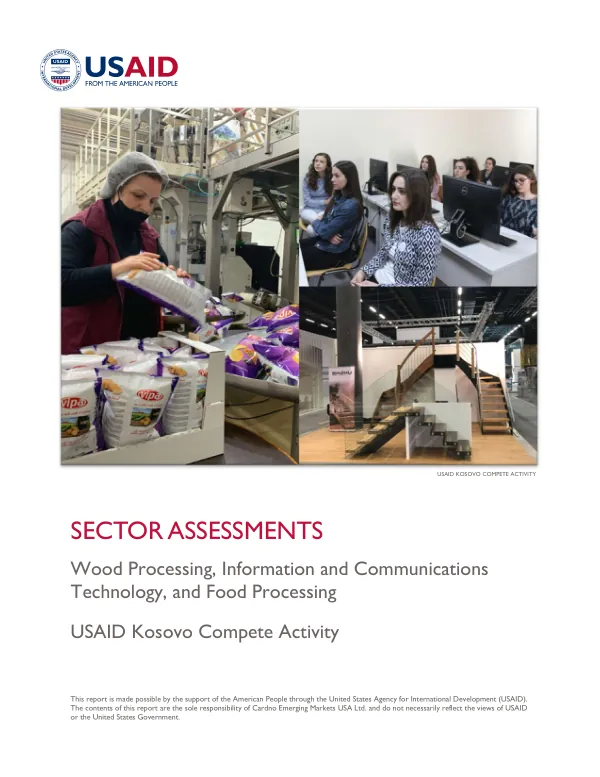
The purpose of the Activity is to promote resilient, self-sustaining market systems and facilitate the private sector's improved competitiveness in local, regional, and global markets. Compete focuses on three key export-oriented sectors: Wood Processing, Information and Communications Technologies (ICT), and Food Processing. The Activity utilizes a market systems approach aligned with USAID's Private Sector Engagement Policy. Compete's work across the three sectors is organized along five functional areas: market access, diversified finance, business sophistication, skills development, and supporting business environment. By addressing constraints across the system, the Activity aims to enable scalable and systemic change, stimulate job creation, and foster the private sector's increased ability to engage in local, regional, and international markets. A comprehensive assessment of the market system of each focus sector was conducted during the period September – December 2020. The study identified system-level constraints in the market systems of the wood processing, ICT, and food processing sectors. The results of the analysis were captured in the Market System Constraints Analysis (MSCA) assessment submitted in November 2020 and subsequently finalized in December 2020. The study used a methodology known as value network analysis (VNA) to capture systemic roles and relationships among key actors in a market system. Compete identified key roles played by main actors in each market system, including input supply, skills development, transport, finance, production, export, wholesale/retail, and regulation oversight. The study also identified key flows among market system actors, such as financial resources, raw materials, information, products, and cash. During the identification of market system constraints in each of the three respective focus sectors, it became evident that a number of constraints were common to all three industries. The most pronounced common constraints identified are limited market access, limited diversified finance, and limited business sophistication. Limited market access is a common constraint that affects all three market systems. The financial sector in Kosovo is oriented toward consumer banking and real estate finance, with insufficient attention paid to the needs of producers, processors, and service providers. The lack of contract-based financing is a particularly significant constraint, as it forces wood and food processors and ICT firms to draw on their existing assets for the working capital they need to meet new orders for their products and services. Limited business sophistication is a common constraint that affects all three market systems. Wood processors and food processors show similar characteristics and face similar challenges. Principally, they tend to have rudimentary business models: family-run management with limited capacity for the challenging task of accessing and sustaining linkages with export markets. They also tend to underinvest in digital business solutions that boost productivity, and relatively few of them possess the international certifications required by many international trading partners. The proposed interventions related to these constraints are found under the Market Access, Diversified Finance, and Business Sophistication functional areas. These interventions aim to address the common constraints identified in the market systems of the wood processing, ICT, and food processing sectors.